astronauticsnow.com/SpaceEducation/
Major challenge for the American space enterprise
The acute need to improve space-related education has emerged as a major challenge for the American space enterprise. At the same time, the importance of space continues to grow for national security and economy. The United States depends on space assets more than any other nation on earth and this country leads the world in exploration and utilization of space.
Government, Congress, and industry have produced alarming reports on the state of the American space workforce during last two decades. Whether these findings collect dust on library shelves or translate into changes depend on a concerted effort by all stakeholders, including the space industry, government, academia, and professional societies, especially the American Institute of Aeronautics and Astronautics (AIAA).
To meet the challenge, Mike Gruntman founded the Astronautics Program at the University of Southern California (USC) in the mid-1990s. Already in 2002, the University noted that "his knowledge, vision, energy, exuberance, and effort have built innovative and successful degree programs in Astronautics, turn[ed] around the aerospace program at USC, which had undergone economy-related retrenchment in the early 1990s."
Mike served as the founding chairman of a new space-focused Department of Astronautical Engineering (ASTE) at USC from 2004-2007 and guided its spectacular growth. Mission accomplished! This is a unique development in space engineering education in the United States, and this is a unique department. He chaired the department again from 2016–2019. In 2024, the University celebrated the 20th anniversary of the Astronautical Engineering Department. Since the early 2000s, Mike has been calling for creation of independent academic departments in space engineering in U.S. universities.
USC Astronautics: Mike joins USC (details) Accelerating the Future, 2002 Establishment of ASTD, 2004 ASTE 20th Anniversary, 2025 30+ Years of Master's Program
Mike has been leading single-handedly and without interruption program's nationally and internationally prominent flagship component, Master of Science in Astronautical Engineering (MS ASTE), since mid-1990s (pdf; video). During the first 22 years of the new department (2014-2026), it awarded nearly 1200 degrees Master of Science in Astronautical Engineering, a significant contribution to the workforce development of space and defense industries of the United States and national security and economic prowess of the country. Many students graduated with Bachelor's and PhD degrees as well. Mike's graduate course on space systems was among largest in this engineering field in the country. Nearly 2600 graduate students took this class from 1994-2026. Mike also teaches short courses on fundamentals of space systems for government and industry.
In July 2026, Mike stepped down, after 30+ years, from his role in the Department to focus on other professional and scholarly pursuits in rocketry, space, missile defense, and others.
Mike's program in space engineering has reached national and international prominence.
Now, it is up to the USC Viterbi School of Engineering to either further strengthen the unique program or let it reenter the atmosphere.
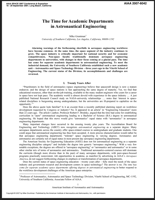
Call for major changes: The Time for Academic Departments in Astronautical Engineering
Call to arms
The Time for Academic Departments in Astronautical Engineering (pdf), AIAA–2007–6042, 2007)
Publications about USC Astronautics (pdf; video)
Sputnik Explorer Vanguard Astronautics Missile defense Baikonur Tyuratam Saryshagan Rocket equation Neil Armstrong at USC and on the Moon
USC USC Astronautics Space Education History Energetic Neutral Atoms ENAs
U-2 Rocket espionage Make the World a Better Place Sic transit gloria universitatum History
USC Program Master of Science in Astronautical Engineering
Awarded (annual) Master's degrees in Astronautical Engineering

National reach of the USC Master's program in Astronautical Engineering


NASA Administrator Charles Bolden (left) at the 49th AIAA Aerospace Sciences Meeting in Orlando, Fla. (January 5, 2011) and Appollo astronaut Buzz Aldrin (right) at ASTE event (December 13, 2011)
|
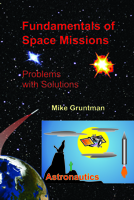
160+ problems with detailed solutions
|
 |
|
Privacy policy. Copyright © 2004–2014. All rights reserved.