Master of Science in Astronautical Engineering

Frequently asked questions (FAQ)

Astronauticsnow.com hosts this web site
for the USC/VSOE Astronautics Program
as public service in support of space education

Master of Science in Astronautical Engineering  –  MS ASTE  – 
is a unique degree program focused on spacecraft engineering.
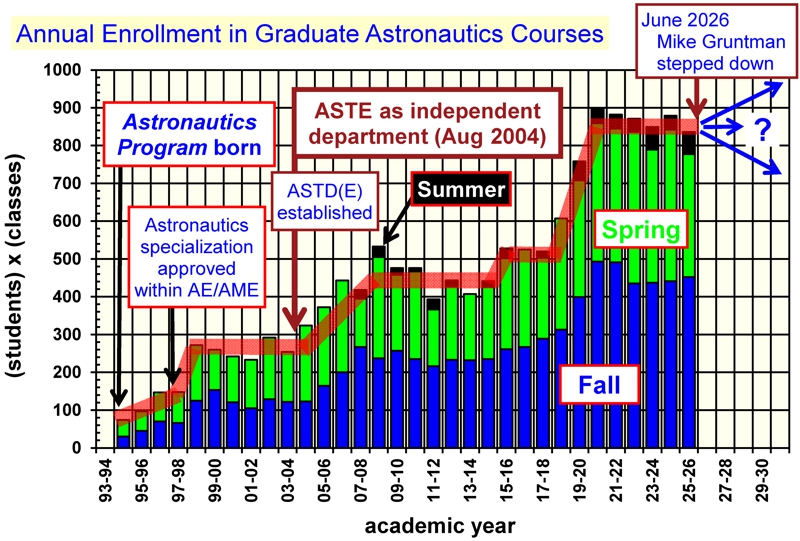
Program structure, history, focus, and enrollment dynamics.

Astronautical Engineering Division (ASTD) (formerly known as the Astronautics and Space Technology Division) of the Viterbi School of Engineering at the University of Southern California offers this degree program as part of a comprehensive set of degrees (BS, BS Minor, MS, Engineer, PhD, and Certificate) in astronautics and space technology.

Information about program admission, curriculum, faculty, etc. is at ASTD's MS ASTE web site.


MS ASTE =  Master of Science in Astronautical Engineering
ASTD       Astronautical Engineering Division
                     formerly known as the Astronautics and Space Technology Division
DEN         =  VSOE's Distance Education Network

VSOE       =  USC's Viterbi School of Engineering
USC         =  University of Southern California


Frequently asked questions:


Space engineering program at USC

Recent changes in the Master's Degree Program

Master's Degree for students residing outside California
Master's Degree through Distance Education
Full-time on campus students
Students working full time
Students serving in the military
"Nontraditional" students
Student abroad
Jobs for graduates

Bachelor of Science in Astronautical Engineering
Engineer in Astronautical Engineering
PhD in Astronautical Engineering

Required coursework
Areas of specialization (concentration)
Coursework for areas of specialization (concentration)
Schedule of courses
Thesis

Webcasts through Distance Education Network
PC vs Mac

Admission requirements
Financial aid
Chances to be admitted to the program MS ASTE
Chances to receive TA (Teaching Assistant) or Research Assistant (RA)

BS degree not in astronautical engineering
BS degree in computer science
Transfer from other programs
Transfer from aerospace engineering program

Undergraduate GPA lower than 3.0
Weak credentials
Do not have GRE scores yet
Beginning studies before being formally admitted to the program
Beginning studies before selecting the degree to pursue

Limited enrollment

Course load for students working full time
Attending a class meeting on campus by a DEN student

Waiver of the required course
Waiver of the required mathematics course
Course credit when transferring to MS ASTE from other USC programs
Course credit when transferring to MS ASTE from other institutions
Choice of technical elective courses
Approval of technical elective courses
Selection of technical elective courses
Courses at summer session (camp) of International Space University (ISU)

Admission of international students to MS in ASTE
Financial aid to international students to MS in ASTE
Coursework and projects open to international students
Job prospects in the United States for foreign students after graduation 

Transition to new MS ASTE program requirements

Application to new MS ASTE after 1 January 2009
Students currently pursuing MS ASTE – following the old program requirements
Students currently pursuing MS ASTE – switching to new program requirements
Students with MS ASTE applications (prior to 1 January 2009) being currently processed
Course requirements prior to 1 January 2009


Space engineering program at USC
Space engineering programs are usually part of aerospace engineering departments. At USC, the AME's aerospace program focuses on aeronautical and fluid mechanics part of aerospace, while all space is in a separate academic unit, the Astronautical Engineering Division (ASTD). Why is this?

A space-focused engineering program (aerospace engineering with specialization in astronautics and space engineering) was established in the USC Viterbi School of Engineering (VSOE) in 1990s. The Master's space program grew spectacularly, focusing on serving educational needs of the space industry and government (NASA, Air Force, etc) space research and development centers. The program became one of the largest in the United States.

In 2004, in order to position the VSOE to take full advantage of rapidly growing opportunities in space, then Dean of Engineering (now USC Provost) Prof. Max Nikias established a new Astronautics and Space Technology Division (ASTD). ASTD is an independent academic unit within the Viterbi School of Engineering and it functions as a regular academic department. (So, ASTD is an academic department as any other electrical engineering, chemical engineering, etc. in VSOE.) In April 2009, USC approved the new name for the division, the Astronautical Engineering Division (ASTD).

ASTD assumed immediate charge of all degree programs with specialization in astronautics and space technology and took over 24 space-focused courses transferred to ASTD from the Department of Aerospace and Mechanical Engineering (AME).  A year later the University approved a full set of new degrees (BS, BS Minor, MS, Engineer, PhD, and Graduate Certificate) in Astronautical Engineering, Code ASTE.  The remaining aerospace program in the AME Department  focuses on aeronautical and fluid mechanics parts of aerospace. All space programs are in ASTD.

The USC program in astronautics and space technology is a unique, and perhaps the largest, pure-space-focused engineering program in the United States. In January 2009, the University of Southern California approved major revision of the program course requirements (see below).

Presently, Astronautics faculty suggests the following areas of concentration:

Spacecraft propulsion
Spacecraft dynamics
Space systems design
Spacecraft systems
Space applications

More about the structure, history, focus, and enrollment dynamics of the USC Astronautics program and on challenges of space engineering education in the United States.  


Recent changes in the Master's Program
Degree program Master of Science in Astronautical Engineering (MS ASTE) has significantly changed. What happened? How will it affect me?

In early January 2008, the University of Southern California approved major changes in the degree program Master of Science in Astronautical Engineering (MS ASTE). This program restructuring will solidify VSOE national leadership in astronautical and space technology education by offering a comprehensive Master's degree program focused on meeting educational needs of the space/defense industry and government space research and development centers. In particular, the new program will insure that all program graduates gain basic knowledge in four key areas of astronautical engineering: fundamentals of space systems; space environment and spacecraft interactions; orbital mechanics; and spacecraft propulsion.

All students currently enrolled in MS ASTE program have a one-time choice: (1) completing the the program under old requirements during academic years 20092012; or (2)  transition to new course requirements. The applicants with applications currently being processed and submitted prior to 1 January 2009 have the same one-time choice. If you decide to switch to new course requirements, please contact ASTD Student Affairs.

Beginning 1 January 2009, all new student applications will be accepted only to the program with the new course requirements. For the reference, the old course requirement is given in the section at the bottom of this web site.

MS ASTE admission requirements and total number of course units are unchanged.


Master's Degree for students residing outside California.
I do not live in the Los Angeles area. In fact I reside outside California. Can I receive the degree Master of Science in Astronautical Engineering ?

Yes, you can receive the degree Master of Science in Astronautical Engineering through VSOE's Distance Education Network. In fact, majority of Astronautics students today enroll in the program as online students. Our students hail from many states of the United States. Some our students who are on active duty are even station abroad.

Master's Degree through Distance Education.
Can I receive the degree Master of Science in Astronautical Engineering taking classes exclusively through the Distance Education Network?

Absolutely. All Astronautics required courses and all core elective courses are available on line through webcasting by VSOE's Distance Education Network. In fact, majority of Astronautics students today enroll in the program as online students.

As a matter of policy, VSOE treats all students – on-campus and online – equally, with identical requirements toward the degrees and standards in student admission and in evaluating student performance. Although online students watch their lectures remotely from the comfort of their home or office, they are held to the same high standards as all USC students and are expected to show the same dedication toward their education. This policy is an effective mechanism of quality control.

See also MS ASTE on DEN

Full-time on campus students.
Can I receive the degree Master of Science in Astronautical Engineering attending classes as a full-time student?

Certainly. In fact about 20%  of our students pursuing Master's degree in Astronautical Engineering are full-time on-campus students. (The remaining 80% of the students are employed by the space industry and government space research and development centers and take their classes through DEN.)

A full-time graduate student not engaged in research could complete the degree in one year of two or three semesters. Some full-time graduate students also engage in research projects and complete the degree requirements in three or four semesters.

Students working full-time.
I work full time. Can I receive the degree Master of Science in Astronautical Engineering through the Distance Education Network while working full-time?

Yes. The Master of Science program in Astronautical Engineering focuses on students who work full-time while earning their degrees. These students (about 80% of the total number) are employed by the space industry and government space research and development centers and take their classes through DEN. The remaining 20% of our students are full-time on-campus students.

Most of the students working full time take one or occasionally two courses every semester. The students are highly motivated and their workload at the main job determines the possible load. Consequently, their typical time of studies ranges from two and half to four years. Many online education students today earn their degree without ever visiting the campus.

Usually Astronautics students desire to get in-depth knowledge in the technical area of their present job. There is another large category of students, however, who concentrate on the areas of technology in which they would like to transfer to in their companies. Specializing (selecting coursework) in the desired areas often facilitates such internal moves.

The statistics of student enrollment in the program flagship course ASTE 520 Spacecraft Systems Design shows that each year students in this class hail from 10 to 14 states within the United States. Excellent technical capabilities and organization of the Distance Education Network make possible for students from everywhere in the United States to conveniently pursue the degree Master of Science in Astronautical Engineering.

See also MS ASTE on DEN

Students serving in the military.
I am an Air Force (Navy, Army, Marines, Coast Guard, IC) officer stationed in ... . Can I receive the degree Master of Science in Astronautical Engineering through the Distance Education Network?

Certainly. In fact, we always have students who serve in the armed forces. While some of them are deployed in "obvious" national-security-space-related units, such as Space and Missile Systems Center (SMC) at the Los Angeles Air Force Base, others serve in sometimes unrelated-to-space units and capacities (pilots, doctors, logistics, etc). We also had students stationed overseas. Accessibility of DEN webcasting is especially advantageous for students who are periodically transferred to various locations. Students can also interrupt their studies when temporarily deployed to the areas with limited broadband connection or other restrictions.

See also MS ASTE on DEN

"Nontraditional" students
I am what you would call a "non-traditional" perspective student
I am 40+ years old ... (or, my background was in management engineering projects last ten years ...; or, I am an airline pilot ...; or, I am a medical doctor ...; or, I am a software entrepreneur ...; or, .....).  Will I fit into the program Master of Science in Astronautical Engineering?

Your case is not unique, though special. Our program is large and we always have several students who are in their forties (and sometimes even fifties), or who were out of school for 20+ years, who were mainly involved in managing engineering projects rather than doing engineering in the trenches, etc. We often have a few students with backgrounds outside engineering or physical and chemical sciences, such as computer science entrepreneurs, biomedical scientists, and even medical doctors. All such students are highly motivated, mature, and successful. You will likely succeed with motivation and hard work.

Student abroad.
I reside in Germany (Australia, ....). Can I receive the degree Master of Science in Astronautical Engineering through the Distance Education Network while living outside the United States?

We have many such requests. Please check with the Distance Education Network (DEN) that evaluates such requests. In the past DEN experimented with such arrangements, then discontinued it. Today, there are a few new arrangements in specific cases. So, please check with DEN this is a dynamic area.

See also MS ASTE on DEN

Jobs for graduates.
Where do program graduates work? What are my chances of getting the job?

Most of our graduates work in the space industry and government space research and development centers.

We cannot guarantee you a job after graduation. However, you may wish to consider the following: most of our students already work full time in the American space enterprise, and they have a choice of which schools to attend and which degrees to pursue. They have chosen USC's program in Astronautical Engineering. The program grew spectacularly during the last ten years (see Program structure, history, focus, and enrollment dynamics.). So, our enrollment dynamics clearly indicates that our degree Master of Science in Astronautical Engineering meets important needs of the space industry and government space R&D centers.


Bachelor of Science in Astronautical Engineering.
Does ASTD offer the Bachelor of Science degree in Astronautical Engineering?

Yes. ASTD offers a full set of degrees Bachelor of Science, Bachelor of Science Minor, Master of Science, Engineer, PhD, and Graduate Certificate    in Astronautical Engineering. For more information, please contact ASTD Student Affairs and Faculty Advisor of the program of interest.

Engineer in Astronautical Engineering.
Does ASTD offer the Engineer degree in Astronautical Engineering?

Yes. ASTD offers a full set of degrees Bachelor of Science, Bachelor of Science Minor, Master of Science, Engineer, PhD, and Graduate Certificate    in Astronautical Engineering. For more information, please contact ASTD Student Affairs and Faculty Advisor of the program of interest.

PhD in Astronautical Engineering.
Does ASTD offer the PhD degree in Astronautical Engineering?

Yes. ASTD offers a full set of degrees Bachelor of Science, Bachelor of Science Minor, Master of Science, Engineer, PhD, and Graduate Certificate    in Astronautical Engineering. For more information, please contact ASTD Student Affairs and Faculty Advisor of the program of interest.


Required coursework.
What is the required coursework for the degree Master of Science in astronautical engineering?

Students are required to take the total of 9 courses (27 units of coursework; a typical course is 3 units).

1)    Four (4) required astronautics courses (12 units) all available through DEN:

ASTE 520 Spacecraft Systems Design
ASTE 470 Spacecraft Propulsion
ASTE 535 Space Environment and Spacecraft Interactions
ASTE 580 Orbital Mechanics I

ASTE 520 is also highly popular among students pursuing other (than Astronautics) engineering degrees who intend to work in the space industry and/or government space research and development centers.

2)    Two (2) core elective astronautics courses (6 units) from the list of core courses. The current list of core electives includes (all courses are offered through DEN with the exception of ASTE 501ab and ASTE 581. ASTE 527 will be offered through DEN for the first time in the fall semester of 2009.):

ASTE 501ab Physical Gas Dynamics
ASTE 523 Design of Low Cost Space Missions
ASTE 527 Space Studio Architecting
ASTE 552 Spacecraft Thermal Control
ASTE 553 Systems for Remote Sensing from Space
ASTE 554 Spacecraft Sensors
ASTE 556 Spacecraft Structural Dynamics
ASTE 570 Liquid Rocket Propulsion
ASTE 572 Advanced Spacecraft Propulsion
ASTE 581 Orbital Mechanics II
ASTE 583 Space Navigation Principles and Practice
ASTE 584 Spacecraft Power Systems
ASTE 585 Spacecraft Attitude Control
ASTE 586 Spacecraft Attitude Dynamics

3)    Two (2) technical elective courses (6 units). 

Most students choose technical electives from the list of core technical elective courses.

Sometimes student's educational objectives require technical elective courses offered by other engineering departments or by science (e.g., physics) departments. We usually approve practically all graduate science and engineering courses as technical electives toward MS ASTE. (A few exceptions include not-purely-technical courses such as those focused on management, economics, etc.). An approval of a technical elective outside astronautics is straightforward email your request to the faculty advisor.

4)    One (1) engineering mathematics (3 units) requirement courses to be chosen from the following 5 courses (all courses offered through DEN with the exception of PHYS 510):

AME 525 Engineering Analysis
AME 526 Engineering Analytical Methods
CE   529a Finite Element Analysis
EE   517 Statistics for Engineers
PHYS 510 Methods of Theoretical Physics

Areas of concentration
Are there suggested areas of specialization (concentration)? Do I have to identify my area of concentration?

Presently, Astronautics faculty suggests the following areas of concentration:

Spacecraft propulsion
Spacecraft dynamics
Space systems design
Spacecraft systems
Space applications

These five tracks, or areas of specialization (concentration), within the program do not appear in transcripts or have separate post-codes, and they are used for advising students on different routes to the degrees meeting their educational objectives. These tracks also help to describe the program to perspective students.

You do not have to identify your area of specialization (concentration) and can select the courses outside of the suggested tracks.

Coursework for areas of concentration
What are the coursework for suggested areas of specialization (concentration)?

Presently, Astronautics faculty suggests the following areas of concentration:

Spacecraft propulsion
Spacecraft dynamics
Space systems design
Spacecraft systems
Space applications

These five tracks, or areas of specialization (concentration), within the program do not appear in transcripts or have separate post-codes, and they are used for advising students on different routes to the degrees meeting their educational objectives. These tracks also help to describe the program to perspective students.

Students choose core elective and technical elective courses that best meet their educational objectives. Students can also concentrate their studies in the desired areas by selecting corresponding core elective courses. Presently, ASTD faculty suggests the following areas of concentration:

Spacecraft propulsion
Choose two core electives from

ASTE 501ab Physical Gas Dynamics
ASTE 570 Liquid Rocket Propulsion
ASTE 572 Advanced Spacecraft Propulsion
ASTE 584 Spacecraft Power Systems

Spacecraft dynamics
Choose two core electives from

ASTE 556 Spacecraft Structural Dynamics
ASTE 581 Orbital Mechanics II
ASTE 583 Space Navigation: Principles and Practice
ASTE 585 Spacecraft Attitude Control
ASTE 586 Spacecraft Attitude Dynamics

Space system design
Choose two core electives from

ASTE 523 Design of Low Cost Space Missions
ASTE 527 Space Studio Architecting
(SAE 549 System Architecting I, 3 units, is also suggested
as technical elective for this area of concentration.)

Spacecraft systems
Choose two core electives from

ASTE 552 Spacecraft Thermal Control
ASTE 553 Systems for Remote Sensing from Space
ASTE 554 Spacecraft Sensors
ASTE 584 Spacecraft Power Systems

Space applications
Choose two core electives from

ASTE 527 Space Studio Architecting
ASTE 553 Systems for Remote Sensing from Space
ASTE 554 Spacecraft Sensors

Schedule of courses.
What is the schedule of astronautics courses?

ASTD-offered courses cover a wide range of topics in astronautics and space technology. DEN webcasts most of the courses, although a few courses are on-campus only. All required courses are offered every year as well as a few elective courses, such as orbital mechanics. Many highly specialized courses are offered every other year. The latter arrangement allows us to use the same number of precious DEN slots for a larger number of available courses. Since it takes about four years for most full-time-working students to complete their studies, careful planning of their coursework usually allows students to take all the desired courses.  Always check with ASTD Student Affairs schedules for courses you plan to take. Preliminary schedule of courses in astronautical engineering for MS ASTE.

Thesis.
Is the thesis required?

No, we do no not require the thesis to achieve MS ASTE. However, a student has an option of writing a thesis. Please contact the faculty advisor in advance. Four units of coursework are credited for the thesis. This is slightly more than one course but requires a significantly larger effort. Consequently, few students choose to pursue the thesis. One can augment the thesis credit  by additionally taking 13 units of directed research. 


Webcasts through Distance Education Network
How many times can I watch webcasts of course lectures.

After a course lecture is delivered, it stays on the university server for the duration of the entire semester.  All students enrolled in class on-campus and remote students have access to lecture webcasts. You can watch the lectures as many time as you need.  

PC vs Mac
Should I use PC or Mac for watching lecture webcasts?

Distance Education Network streams course videos using Microsoft Windows media encoders and servers. While streaming windows media files are supported by both the latest Mac and PC operating systems, using a Windows based system will usually provide a better experience. Additionally, DEN has recently added video download capabilities using Microsoft’s Digital Rights Management supporting Windows operating systems.


Admission requirements.
What are the admission requirements to the degree program Master of Science in Astronautical Engineering?

The admission to MS ASTE is based on the totality of applicant's record which includes GPA, GRE, and two letters of recommendation.

Required items:

Application – send to Office of Grad. and Int’l Admission
Official Transcript(s)
– send to Office of Grad. and Int’l Admission
General Record Exam
– send to Office of Grad. and Int’l Admission
TOEFL (international students only)
– send to Office of Grad. and Int’l Admission
Recommendation Letters
– send to Office of Grad. and Int’l Admission

Application

All applications should be submitted on-line at http://www.usc.edu/admission/graduate/apply/

Official Transcript(s)

The University requires official transcripts from the accredited colleges or universities the applicant has attended. The MS Degree Program in Astronautical Engineering (Code ASTE) requires a minimum GPA of 3.0.

General Record Exam

The Astronautics and Space Technology Division requires the general GRE. The GRE must be taken within five years of the application date.

TOEFL (International Students only)

The University and the Viterbi School do not require TOEFL test results. However, if an international student takes the TOEFL test and earns a score of 600 or above on the paper test, or a 100 or above (with minimum of 20 on each section) of the internet-based test, he/she will be excused from taking the International Student Test of English, which is normally required of all foreign students when they arrive at USC to determine their level of English language proficiency. TOEFL test scores are valid for two years.

Recommendation Letters

Please provide two professional letters of reference (former instructors, supervisors, professional colleagues, advisors, etc.) to be filed through the on-line application process.

Mailing addresses, if needed

Office of Graduate and International Admission
University of Southern California
Los Angeles, CA 90089-0911

Astronautics and Space Technology Division
ASTE Graduate Program
University of Southern California
854 W. Downey Way
Los Angeles, CA 90089-1192

Application deadline:

 30 April for fall; 1 October for spring; 15 February for summer.

Please note that verification and processing of materials by the Office of Graduate and International Admission may take four to six weeks.

Financial aid.
What financial aid is available for students?

Two common types of the financial aid to students are teaching assistantships (TAs) and research assistantships (RAs). 

TAships are awarded by academic departments and involve duties in support of classes. Chair of ASTD makes the awards of TAships based on the applicant's record and programmatic need of ASTD. You must apply for financial aid (TA) to be considered for TA. Check with ASTD Student Affairs for the deadlines. TA awards are usually made to full-time on-campus students. The VSOE policy requires making TA awards to students pursuing PhD degrees.

RAships are awarded by individual faculty members (Principal Investigators) conducting R&D work supported by their grants and contracts. You need to directly contact individual faculty members to inquire whether they are looking for Research Assistants. The VSOE prefers RA awards to be made to students pursuing PhD degrees, but the decision is of the faculty member (Principal Investigator).

Chances to be admitted to the program MS ASTE.
What are my chances to be admitted to the degree program Master of Science in Astronautical Engineering?

The admission to MS ASTE is based on the totality of applicant's record which includes GPA, GRE, and two recommendation letters. We cannot and do not assess the chances of applicants to be admitted to the program. One has to submit the application.

Chances to receive TA (Teaching Assistant) or Research Assistant (RA).
What are my chances to Teaching Assistantship (TA) or Research Assistantship (RA) ?

Two common types of the financial aid to students are teaching assistantships (TAs) and research assistantships (RAs).  TAships are awarded by academic departments and involve duties in support of classes. Chair of ASTD makes the awards of TAships based on the applicant's record and programmatic need of ASTD. You must apply for financial aid (TA) to be considered for TA. Check with ASTD Student Affairs for the deadlines. We cannot and do not assess the chances of applicants to be awarded TAships. One has to submit the application.

RAships are awarded by individual faculty members conducting R&D work supported by their grants and contracts. You need to directly contact individual faculty members to inquire whether they are looking for Research Assistants.


BS degree not in astronautical engineering.
My Bachelor of Science degree is not in astronautical engineering. Can I apply for admission to the degree program Master of Science in Astronautical Engineering?

The admission requirement to the degree program Master of Science in Astronautical Engineering is a Bachelor of Science degree in science or engineering. If your degree is in physics, chemistry, astronomy, mechanical engineering, electrical engineering, chemical engineering, civil engineering, etc., then you are eligible for admission to the program. A degree in computer science (CS) is an exception – see below.

BS degree in computer science.
My Bachelor of Science degree is in computer science. Can I apply for admission to the degree program Master of Science in Astronautical Engineering?

Pursuing the degree of Master of Science in Astronautical Engineering requires background that includes typical undergraduate courses in physics and mathematics. If you took such courses then you may be admitted to the program. The decision to admit to the degree program Master of Science in Astronautical Engineering is made based on the totality of the applicant’s record. If your coursework provides the required physics and mathematics background (typical for a graduate in science or engineering) then you may be admitted to the program.

Transfer from other programs.
I am currently enrolled in an engineering Master's program other than Astronautical Engineering. I want to transfer to the program Master of Science in Astronautical Engineering. What should I do?

The degree Master of Science in Astronautical Engineering, Code ASTE, is offered by the Astronautics and Space Technology Division (ASTD) of the USC Viterbi School of Engineering.

Transfer Process – Engineering Students
The transfer to a program in Astronautical Engineering, Code ASTE, requires an engineering student to fill out a simple form (Form 4067) and submit it to ASTD Student Affairs. After the student admission is approved by the MS ASTE Faculty Advisor or ASTD Chair, the student returns the form to the Registrar’s Office for processing.

Transfer Process – Non-Engineering Students
Transfer to a program in Astronautical Engineering, Code ASTE, requires a non-engineering student to file the USC application for graduate admission to the program in Astronautical Engineering. Processing of the application does not require re-submission of supporting documents (e.g., transcripts) that have been previously submitted to USC. Check with ASTD Student Affairs.

Restrictions
Transfer to a program in Astronautical Engineering, Code ASTE, cannot be requested during the first semester of student studies at USC.

Transfer from aerospace engineering program.
My passion is space exploration and technology and I recently enrolled in VSOE MS program in Aerospace Engineering. Soon, I have discovered that all astronautics and space technology is in ASTD. What should I do?

The aerospace program in the Aerospace and Mechanical Engineering (AME) Department  focuses on aeronautical and fluid mechanics part of aerospace. All space programs are in the VSOE's Astronautics and Space Technology Division (ASTD). See FAQ Space engineering program at USC.

ASTD offers a full set of degrees (BS, BS Minor, MS, Engineer, PhD, and Graduate Certificate) in Astronautical Engineering, Code ASTE.

Transfer Process
The transfer to a program in Astronautical Engineering, Code ASTE, from AME's program in Aerospace Engineering requires a student to fill out a simple form (Form 4067) and submit it to ASTD Student Affairs. After the student admission is approved by the MS ASTE Faculty Advisor or ASTD Chair, the student returns the form to the Registrar’s Office for processing.


Undergraduate GPA lower than 3.0.
My undergraduate GPA is lower than the required 3.0 for a graduate program at USC. Astronautics is my passion and I work (want to work) in the space industry or a government space research and development center. Is there any way that I can be admitted to the degree program Master of Science in Astronautical Engineering?

The decision to admit to the program the degree program Master of Science in Astronautical Engineering is made based on the totality of the applicant’s record, including GPA, GRE, and recommendation letters. The only way to find out whether you can be admitted to the program is to apply for admission. We cannot and do not assess the chances of admission without evaluating the full application. Obviously, high scores on GRE and strong letters of recommendation become especially important in case of low GPA.

Weak credentials.
My credentials (GPA, degree, letters of recommendation, etc) are not strong. Can I enroll as a limited student to prove that I will successfully complete the MS ASTE program?

We appreciate that you may be successful in our graduate program, however eligibility for Limited enrollment absolutely requires indication of admission based on undergraduate performance. Limited enrollment is to provide strong candidates for admission the opportunity to get started, without having to wait for the next admissions cycle. Strong candidacy is indicated by a B.S. in engineering, math or science from a regionally-accredited institution with a GPA of 3.00 or above. DEN does not have the authority to evaluate beyond those three criteria.

Students who do not meet these standards must apply for admission. This provides the applicant the opportunity to submit letters of recommendation and a statement of purpose in order to give a complete picture that also includes transcripts and GRE scores. This information will be evaluated by admissions officers and faculty who can best determine a student's qualification. The process can only be undertaken if a student formally applies.

Do not have GRE scores yet.
My GPA is OK (>3.0) but I have not passed the GRE yet. Is there any way that I can begin studies towards the degree Master of Science in Astronautical Engineering while preparing for and taking my GRE tests?

There is a good news for you. While you cannot be admitted to the program MS ASTE without the GRE, you can begin taking classes on a conditional basis while preparing for and taking the GRE. You need to apply to DEN for enrollment as a limited student. After your limited-student application is processed, DEN will allow you to enroll in the classes. Then you can apply for formal admission to the degree program Master of Science in Astronautical Engineering while already taking courses. Up to four courses taken as a limited status student will be later credited toward your Master's degree when you are formally admitted to the program. It is a win-win situation.

Enrollment as a limited student DEN requires that you have a BS degree in science or engineering with a GPA of at least 3.0 from a regionally accredited university. There will be a time limit for you to complete your GRE tests and apply for admission to the program.

Note that the condition of GPA at least 3.0 is not negotiable. If your GPA is less than 3.0, you cannot be admitted as a limited student. Your only option is to apply for admission to the program MS ASTE, providing GRE scores and letters of recommendation.

Beginning studies before being formally admitted to the program.
I plan to apply to the degree program Master of Science in Astronautical Engineering. The application process takes time and the deadline has been passed for the forthcoming semester.  Is there a way for me to begin studies before being formally admitted to the program?

Yes, you can begin studies as a limited student before being formally admitted to the program. Actually, this is a common situation for many our students, particularly recent graduates who have been hired to their first jobs and eager to continue their education. You need to apply for enrollment as a limited status student through the Viterbi School’s Distance Education Network DEN. After the application is processed, DEN will allow you to enroll in the classes. Then you can apply for formal admission to the degree program Master of Science in Astronautical Engineering while already taking courses. Up to fours courses taken as a limited status student will be later credited toward your Master's degree when you are formally admitted to the program. It is a win-win situation.

For enrollment as a limited student DEN requires that you have a BS degree in science or engineering with a GPA of at least 3.0 from a regionally accredited university.  There will be a time limit for you to complete your GRE tests and apply for admission to the program.

Beginning studies before selecting the degree to pursue
I would like to pursue the Master of Science degree in engineering but I have not decided on the area of studies yet. I like the degree program Master of Science in Astronautical Engineering but I am not really sure that this is my area. Is there a way to begin studies without being formally admitted to the program in order to better determine my educational objectives?

Yes, you can begin studies before being formally admitted to the program.

You need to apply for enrollment as a limited status student through the Viterbi School’s Distance Education Network DEN. After the application is processed, DEN will allow you to enroll in the classes. Then you can apply for formal admission to the degree program Master of Science in Astronautical Engineering while already taking courses. Up to four courses taken as a limited status student will be later credited toward your Master's degree when you are formally admitted to the program. It is a win-win situation. You can decide while taking courses on the area where you want to pursue your degree.

For enrollment as a limited student DEN requires that you have a BS degree in science or engineering with a GPA of at least 3.0 from a regionally accredited university. There will be a time limit for you to complete your GRE tests and apply for admission to the program.

Limited enrollment
What is limited enrollment? Who can enroll as a limited student?

Limited enrollment is to provide strong candidates for admission the opportunity to get started, without having to wait for the next admissions cycle. Strong candidacy is indicated by a B.S. in engineering, math or science from a regionally-accredited institution with a GPA of 3.00 or above. DEN does not have the authority to evaluate beyond those three criteria.

Students who do not meet these standards must apply for admission. This provides the applicant the opportunity to submit letters of recommendation and a statement of purpose in order to give a complete picture that also includes transcripts and GRE scores. This information will be evaluated by admissions officers and faculty who can best determine a student's qualification. The process can only be undertaken if a student formally applies.


Course load for students working full time.
I am a student pursuing the degree Master of Science in Astronautical Engineering. I work full time and my job is very demanding. How many classes should I take every semester?

Possible course load is very, very individual. My usual advice is to start your studies by enrolling in one course. You will see how this course load is compatible with your job responsibilities. If you see that you can handle more than one course, then you can enroll in two courses next semester. We have seen cases when excellent students, with heavy job responsibilities, enrolled in too many classes and their grades suffered.

Attending a class meeting on campus by a DEN student.
I am a student pursuing the degree Master of Science in Astronautical Engineering though DEN. I work in the Greater Los Angeles area. I wonder whether it would be possible for me to occasionally attend a live class on campus?

Absolutely, you are most welcome to attend live class meetings. Actually, some of our distance student do exactly that. In addition, students from far away places occasionally travel to Los Angeles on business and they also stop by. Please make sure to introduce yourself to the instructor. It is always a pleasure to meet a student whom you know only by name.


Waiver of the required course.
During my undergraduate studies I took a course similar to (significantly overlapping with) the required course for MS ASTE. Can I have this course requirement waived? (The course must be similar in content and at the same level.)

Yes, you can. Actually, we strongly suggest you do exactly that. We have four required courses, Spacecraft Systems Design ASTE 520; Spacecraft Propulsion ASTE 470; Space Environment and Space Interactions ASTE 525; Orbital Mechanics I ASTE 580. So your course must be either a senior-level undergraduate course or a graduate course.

First, you need to send an email to the MS ASTE Program Faculty Advisor (with a copy to ASTD Student Affairs) stating (1) your name and that you pursue MS ASTE; (2) give the name of the course you would like to waive; (3) explain which similar course during your undergraduate studies you took. Please provide (3a) course name and number; (3b) when you took this course and the grade you received; (3c) course instructor; (3d) brief course description or syllabus as in the catalog; (3e) title(s) and author(s) of the course required textbook(s); (3f) whether you had homework assignments; course projects, and exams in the course.

The MS ASTE Program Faculty Advisor will evaluate your request and make a decision whether to grant your request. He may request an instructor teaching the required course (requested to be waived) to help in evaluation of your request. The Faculty Advisor will email you back the decision which must be added to your file in ASTD Student Affairs. It is essential to have the decision on file for your graduation.

Note that the waiver of the required course does not diminish the number of course units required for the MS ASTE degree. You will need to take an additional technical elective instead of the waived required course.

Waiver of the required mathematics course.
During my undergraduate studies (d
uring my graduate studies before I switched to the degree MS ASTE) I had taken a course similar to (significantly overlapping with) the required mathematics course (AME 525; AME 526; CE 529a; EE 517; PHYS 510) for MS ASTE. Can I have this course requirement waived? (The course must be similar in content and at the same level.)

Yes, you can petition for the course waiver. The first step is to obtain the approval by an instructor who teaches this required math course (AME 525; AME 526; CE 529a; EE 517; PHYS 510). The MS ASTE Program Faculty Advisor could approve the waiver only if the instructor of this required math course endorses your request. Note that usually graduate coursework can justify the course waiver.

Course credit when transferring to MS ASTE from other USC programs.
I was originally working on Master's degree in electrical (industrial, aerospace, mechanical, ....) engineering. I want to switch to the degree Master of Science in Astronautical Engineering. Can any of my electrical (industrial, aerospace, physics, electrical, mechanical, ...) courses that I have taken be credited toward my degree in Astronautical Engineering?

Yes, certainly. The coursework for MS ASTE is: 4 required courses (ASTE 520l ASTE 470; ASTE 535; ASTE 580); 1 required mathematics courses (AME 525; AME 526; CE 529a; EE 517; PHYS 510); 2 core elective astronautics courses and 2 technical electives.  The courses that you have taken pursuing another engineering degree can be used as technical electives. We usually approve most (with a few exceptions) graduate engineering and hard science courses. Therefore, the coursework that you have already taken in pursuit of Master's degree in electrical (industrial, aerospace, physics, electrical, mechanical, ...) engineering will most likely be approved as technical electives toward MS ASTE. You need to send an email to MS ASTE Program Faculty Advisor (with a copy to ASTD Student Affairs) with the list of courses you took (provide course numbers and titles) and he will advise you by a return email on suitability of these courses as technical electives.

Course credit when transferring to MS ASTE from other institutions.
While studying at University of Somewhere – before my transfer to USC's program MS in ASTE – I took several graduate courses. Can some of them be credited toward my degree Master of Science in Astronautical Engineering?

USC allows the transfer of up to 4 units of coursework from another institution.  We will allow transfer of graduate coursework only.

The process is as follows:

First, contact Student Services Manager in Degree Progress (Nelson Shirota, shirota@usc.edu) and request to have domestic transfer work made available in GRAD.INFO. Once evaluated, the course work will appear in GRAD.INFO, and the student will receive a graduate transfer credit statement on OASIS.  

Second, the MS ASTE Program Faculty Advisor will evaluate the technical content of the course you wish to transfer. Send a request (email) to the MS ASTE Faculty Advisor with the following information: (a) course name; (b) when you took the course, where, and the grade you received; (c) course syllabus (as in the catalog); (d) the required textbook(s); (e) course instructor; (f) whether there were homework assignments (how many?) , course projects, term papers, and exams in the course. After MS ASTE Faculty Advisor evaluates the courses for suitability for credit transfer, please contact ASTD Student Affairs to have the course applied to your degree.

Choice of technical elective courses.
I am pursuing the degree Master of Science in Astronautical Engineering. Can I take a graduate course in physics (chemistry, astronomy, mechanical engineering, golfing, French literature, cooking, sailing, computer science, business, ...) as a technical elective? I believe this course will help me to achieve my educational objectives.

Most students pursuing the degree Master of Science in Astronautical Engineering choose technical electives from the list of astronautics core technical elective courses.  Sometimes student's educational objectives require technical elective courses offered by other engineering departments or by science departments. Practically all graduate science and engineering are usually approved as technical elective toward MS ASTE. (A few exceptions include not-purely-technical courses such as those focused on management, economics, etc.) However, no sailing, cooking, or business courses ...

An approval of a technical elective outside astronautics is straightforward email your request to MS ASTE Faculty Advisor (make sure to include full course name and number).  He will email you back course approval with a copy to ASTD Student Affairs. Please make sure that the approval is added to your file.

Approval of technical elective courses.
How do I obtain an approval to take a technical elective course?

The selection of technical elective courses is student's, subject to approval by the MS ASTE Faculty Advisor. The advisor will help you  (if you need help) to make the selection that best meets your educational goals.

An approval of a technical elective outside astronautics is straightforward email your request to the MS ASTE Faculty Advisor (make sure to include full course name and number).  He will email you back course approval with a copy to ASTD Student Affairs. Please make sure that the approval added to your file. 

Practically all graduate science and engineering are usually approved as technical elective toward MS ASTE. (A few exceptions include not-purely-technical courses such as those focused on management, economics, etc.)

Selection of technical elective courses.
Who decides which technical elective courses I take?

The decision is student's, subject to approval by the MS ASTE Faculty Advisor. The advisor will help you (if you need help) to make the selection that best meets your educational goals. But the selection and decision is yours.

An approval of a technical elective outside astronautics is straightforward email your request to the MS ASTE Faculty Advisor (make sure to include full course name and number).  He will email you back course approval with a copy to ASTD Student Affairs. Please make sure that the approval added to your file.

Courses at summer session (camp) of International Space University (ISU).
I would like to attend a summer session conducted by the International Space University. Can the courses be credited toward the MS in ASTE degree. 

ISU summer session (camp) coursework cannot be credited toward the degree MS ASTE. 


Admission of international students to MS ASTE.
I am graduating with the Bachelors degree and would like to apply to the degree MS ASTE. I live in a foreign country and achieving a degree in astronautics and working on space exploration is my dream. Will my international student and foreign citizen status affect my chances to be admitted to the program MS ASTE?

No, your foreign student status will not affect the decision for your admission to the program. The admission decision is made on the totality of your record, including your undergraduate GPA, GRE scores, and two letters of recommendation. Your citizenship or country of residence plays no role in the admission decision.

Financial aid to international  students to MS ASTE.
I am graduating with the Bachelor's degree and would like to apply to the degree MS ASTE. I live in a foreign country and achieving a degree in astronautics and working on space exploration is my dream. Will my international student and foreign citizen status affect my chances of obtaining financial aid?

You application for financial aid in MS ASTE will be considered in the same way as an application of international students to other engineering graduate programs.

Please see the FAQ on financial aid.

Coursework and projects open to international students
I am graduating with the Bachelor's degree and would like to apply to the degree MS ASTE. I live in a foreign country and achieving a degree in astronautics and working on space exploration is my dream. Will my international student and foreign citizen status affect the opportunity to enroll in the courses and/or to work on space projects during my studies?

USC courses are open to all students regardless of their citizen/residence status. So, there are no restrictions on enrollment in astronautics courses.

Note that many engineering faculty conduct their research and development work supported by grants and contracts awarded by government agencies and private industry. Some of these R&D projects may have restrictions on the participation of foreign nationals. (You may have read/heard about the ITAR regulations.)  You may not be able to join projects with the restrictions. Other projects do not have restrictions on participation of foreign nationals. Note that the participation in R&D projects is in no way required for achieving the degree MS ASTE.

Job prospects in the United States for foreign students
I am graduating with the Bachelor's degree and would like to apply to the degree MS ASTE. I live in a foreign country and achieving a degree in astronautics and working on space exploration is my dream. Will my international student and foreign citizen status affect summer job opportunities during my studies and prospects of getting the job in the space industry after graduation?

Many R&D and industrial programs in astronautics and space technology have restrictions on the participation of foreign nationals. (You may have read/heard about the ITAR regulations.) These programs (companies and R&D centers) will not be able to hire you unless you have a permanent residency status ("green card").

Note that you are not the first in such a situation and certainly not the last.


Application to new MS ASTE after 1 January 2009
I plan to apply to the degree MS ASTE. Do I have a choice of whether to follow the "old" (prior to 1 January 2009) or "new" (after 1 January 2009) coursework requirements? 

No, you do not have a choice. Beginning 1 January 2009, all new student applications will be accepted only to the program with the new course requirements.

MS ASTE admission requirements and total number of course units are unchanged.

Students currently pursuing MS ASTE – following the old program requirements
I am admitted to the program and I am currently pursuing the degree MS ASTE. Can I continue in the program with the "old" (prior to 1 January 2009) coursework requirements? Or, do I have to switch to the "new" (after 1 January 2009) coursework requirements? 

As a student currently admitted to the program and pursuing the degree MS ASTE, you can continue in the program with the "old" (prior to 1 January 2009) coursework requirements.

All students currently enrolled in MS ASTE program have a one-time choice: (1) completing the the program under old requirements during academic years 20092012; or (2)  transition to new course requirements.

The choice must be made not later than the 20092010 academic year. 

Students currently pursuing MS ASTE – switching to new program requirements
I am admitted to the program and I am currently pursuing the degree MS ASTE. Can I switch to to the "new" (after 1 January 2009) coursework requirements? Or, do I have to continue in the program with the "old" (prior to 1 January 2009) coursework requirements?

As a student currently admitted to the program and pursuing the degree MS ASTE, you can switch to the program with the "new" (after 1 January 2009) coursework requirements.

All students currently enrolled in MS ASTE program have a one-time choice: (1) completing the the program under old requirements during academic years 20092012; or (2)  transition to new course requirements.

The switch to the new program must be made not later than the 20092010 academic year.

If you decide to switch to the new course requirements, please contact ASTD Student Affairs.

Students with MS ASTE applications (prior to 1 January 2009) being currently processed
I applied to the program MS ASTE prior to 1 January 2009. Can I continue in the program with the "old" (prior to 1 January 2009) coursework requirements? Can I switch to to the "new" (after 1 January 2009) coursework requirements?

The applicants with applications currently being processed and submitted prior to 1 January 2009 have the same one-time choice as the students currently enrolled in the program.  All students currently enrolled in MS ASTE program have a one-time choice: (1) completing the the program under old requirements during academic years 20092012; or (2)  transition to new course requirements.

The choice must be made not later  than the 20092010 academic year. 

If you decide to switch to new course requirements, please contact ASTD Student Affairs.

MS ASTE admission requirements and total number of course units are unchanged.

MS ASTE Program course work requirements prior to 1 January 2009.
I am admitted the program and I am currently pursuing the degree MS ASTE. I forgot what were the "old" (prior to 1 January 2009) coursework requirements. 

Students are required to take the total of 9 courses (27 units of coursework; a typical course is 3 units).

1)    Two (2) required astronautics courses (all available through DEN):

ASTE 520 Spacecraft Systems Design
ASTE 535 Space Environment and Spacecraft Interactions

These are broad review-type courses. ASTE-520 is also popular among students pursuing other (than Astronautics) engineering degrees who intend to work in the space industry and/or government space research and development centers.

2)    One (1) core technical elective course from the list of core courses. The current list of core electives includes (all available through DEN):

ASTE 470 Spacecraft Propulsion
ASTE 523 Design of Low Cost Space Missions
ASTE 552 Spacecraft Thermal Control
ASTE 553 Systems for Remote Sensing from Space
ASTE 556 Spacecraft Structural Dynamics
ASTE 580 Orbital Mechanics I
ASTE 583 Space Navigation Principles and Practice
ASTE 584 Spacecraft Power Systems
ASTE 585 Spacecraft Attitude Control
ASTE 586 Spacecraft Attitude Dynamics

3)    Two (2) engineering mathematics requirement courses (all available through DEN):

AME 525 Engineering Analysis
AME 526 Engineering Analytical Methods

4)    Four (4) technical elective courses. 

Most students choose technical electives from the list of core technical elective courses.

Sometimes student's educational objectives require technical elective courses offered by other engineering departments or by science (e.g., physics) departments. We usually approve practically all graduate science and engineering courses as technical electives toward MS ASTE. (A few exceptions include not-purely-technical courses such as those focused on management, economics, etc.). An approval of a technical elective outside astronautics is straightforward email your request to the faculty advisor.


Privacy policy.         Copyright © 2008–2009. All rights reserved.