
 –
Mike's books
–
Mike's books
astronauticsnow.com/armstrong/preface.html
Mike's space and rocket videos –
–
Mike's books
|
Book website |
Preface
pp. vii - ix
On January 22, 1970, the School of Engineering of the University of Southern California (USC) conferred a degree of Master of Science (M.S.) in Aerospace Engineering on a student. The press release of the USC News Bureau described the occasion:
A distinguished "member of the student body" of the University of Southern California today completed the academic requirements for his master's degree with the delivery of a scientific lecture on "Lunar Landing: Techniques and Procedures."
His name -- Neil Armstrong. [1]
Neil A. Armstrong, 1930-2012, was among the most renowned USC graduates. In 1955, he became a research test pilot at the High Speed Flight Station (HSFS) of the National Advisory Committee for Aeronautics (NACA) in California. [2] He began graduate studies part-time at USC in September of that year.
Armstrong had completed all graduate coursework except the thesis required for his Master's degree when he transferred to Houston, Texas, in the fall of 1962 after selection to the second group of NASA astronauts. Thus, "one small step" toward the degree remained to be made.
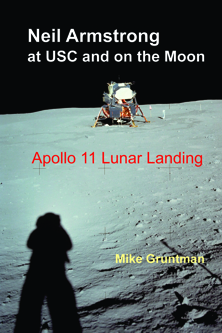
In July 1969, astronaut Neil Armstrong commanded the Apollo 11 space mission to the moon. After entering lunar orbit, Armstrong and Edwin E. "Buzz" Aldrin in the Lunar Module with the callsign Eagle separated from the Command Module Columbia piloted by Michael Collins. On July 20, Armstrong and Aldrin landed in the Sea of Tranquility on the moon, while Collins remained in lunar orbit waiting for their return. Neil Armstrong descended to the surface from the Lunar Module and became the first human to make that famous "one small step for [a] man, one giant leap for mankind." Aldrin followed. The Apollo 11 crew successfully returned to Earth and splashed down in the Pacific Ocean on July 24, 1969.
Six months later, the world-famous Trojan [3] Neil Armstrong came back to USC on January 22, 1970. The astronaut gave an hour-long seminar on the technical aspects of the historic landing of Apollo 11 on the moon. This completed the requirements for the Master's degree, which was conferred on him at the conclusion of his lecture. [4]
[3] – In 1912, the Los Angeles Times used an analogy of ancient Trojans to describe the fighting spirit of USC student-athletes [Bird, 1912]. Since those days, the Trojan has become the proud nickname for USC students, alumni, faculty, and staff.
This book significantly expands a paper [5] presented at a history session of the 75th International Astronautical Congress in Milan, Italy, in 2024. The story begins with Armstrong's graduate studies at USC in the 1950s, based on archival records. Then, it describes his visit to the university campus on that January day in 1970 for the festive dedication of a new major science center in the morning.
Next, the book turns its attention to Apollo, a visionary program to land men on the moon that required the concentration of enormous economic, scientific, and technological resources of the country. Numerous technical details show the challenges of developing, designing, and operating the Apollo spacecraft, particularly its Lunar Modules, which landed the astronauts on the lunar surface, as well as training the crews for this task. The recounted complexity of Apollo 11's historic landing in the Sea of Tranquility on the moon puts into perspective this engineering accomplishment. Many quotes give readers a flavor of how participants viewed the events.
The photographs by NASA's recent lunar orbiting mission show the landing area, with Apollo 11's descent stage standing at the site. The deployed science instruments rest nearby.
Finally, the story returns to Armstrong's visit to USC on January 22, 1970, and his afternoon lecture on the guidance and control of the Lunar Module Eagle. His presentation focused on the technical details of the powered descent and landing on the moon, one of the most challenging elements of the Apollo missions. The event concluded with the Master of Science degree awarded to the astronaut.
Appendix A of the book provides a list of acronyms and abbreviations. Appendix B briefly summarizes Apollo spacecraft missions, from Apollo 4 to Apollo 17, with the names of the astronauts, mission dates, and lunar module serial numbers and callsigns. Appendix C lists more than 80 figures in the book, and Appendix D contains a selected bibliography with more than 140 items. The index, 450+ entries, follows the appendices.
The aerospace field traditionally uses a combination of metric and non-metric units. Many original documents of the Apollo program relied on Imperial units such as feet, pounds, miles, etc. For the convenience of the reader, the presented parameters are given in both the original non-metric and metric units.
The opinions expressed in the book are solely mine. Needless to say, I take the responsibility for all errors.
Mike Gruntman
California
September 2025
It is time to build a space-based missile defense layer (op-ed)
Sputnik Explorer Vanguard Astronautics Missile defense Baikonur Tyuratam Saryshagan Rocket equation Rocket espionage U-2 Neil Armstrong USC