–
Mike's books
–
Mike's books
astronauticsnow.com/armstrong
Mike's space and rocket videos –
–
Mike's books
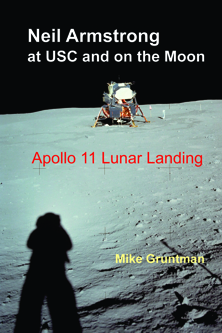
|
Interstellar Trail Press, Los Angeles, 2025
186 pages
with 80+ figures |
|
|
||||
Neil Armstrong at USC and on the Moon:
Apollo 11 Lunar Landing
on Amazon.com
also on
Amazon.co.uk,
.de,
.fr,
.es,
.it,
.ca,
.com.au
Neil Armstrong: From Lunar Landing to Master of Science Degree
(article, 20 pages)
75th International Astronautical Congress, IAC-24-E4.IP.9, Milan, Italy, 2024
About the Book
scroll down to Table of Contents and Book Reviews and Figure List
Book Preface
On January 22, 1970, a "distinguished 'member of the student body'" of the School of Engineering of the University of Southern California (USC) gave a one-hour seminar on techniques and procedures of lunar landing. He thus completed the requirements for the Master's degree in aerospace engineering, which was conferred on him after the lecture. The name of the student was Neil A. Armstrong. Six months earlier, he commanded the Apollo 11 lunar mission and became the first man to set foot on the moon.
The story begins with Armstrong's graduate studies at USC in the 1950s. Then, it describes his return to the university campus on that January day in 1970 for the festive dedication of a new science center in the morning.
Next, the book turns its attention to Apollo, a visionary program to land men on the moon that required the concentration of enormous economic, scientific, and technological resources of the country. Numerous technical details show the challenges of designing, building, and operating the Apollo spacecraft, particularly its Lunar Modules, which landed the astronauts on the lunar surface, as well as training the crews for this task. The recounted complexity of Apollo 11's historic landing in the Sea of Tranquility on the moon puts into perspective this engineering accomplishment. Many quotes give readers a flavor of how participants viewed the events.
Finally, the story returns to Neil Armstrong's visit to USC and his afternoon lecture on the guidance and control of the Lunar Module Eagle during the powered descent and landing on the moon, one of the most challenging elements of the Apollo missions.
The book has more than 80 figures.
Selected bibliography includes more than 450 entries.
About the Author
Dr. Mike Gruntman is a professor of astronautics and the founder of a space engineering program at the University of Southern California. He is an internationally recognized physicist and engineer actively involved in R&D programs in space science and space technology. Mike has authored and co-authored more than 300 scholarly publications, including seven books. He is an Associate Fellow of the American Institute of Aeronautics and Astronautics (AIAA) and a Member (Academician) of the International Academy of Astronautics (IAA).
Mike's books
–
Mike's space and rocket videos –
Neil Armstrong at USC and on the Moon – Contents
Chapter 1. Studies at USC
Training and service in the Navy
Korean war
NACA's (NASA's) High Speed Flight Station
Enrolling in USC program
X-15 rocket plane program
Dyna-Soar space plane program
Classes at USC
Research for Master's thesis
Transfer to Houston for astronaut training
Final attempt to complete the thesis
Chapter 2. Return to USC on January 22, 1970
Dedication of Seaver Science Center
Day full of events
Governor Ronald Reagan at Archimedes Circle dinner
Chapter 3. Apollo Program and NASA
Launch Operations Center at Cape Canaveral
President Kennedy's speech
NASA administrators during the Apollo program
Apollo – enormous national program
NASA and space industry workforce
Top management of Apollo and NASA field centers
Manned Spacecraft Center in Houston
Marshall Space Flight Center in Huntsville
Launch Operations Center at Cape Canaveral
All-up testing by George Mueller
Buildup of Saturn V and Apollo spacecraft
Chapter 4. Apollo Missions and Apollo Spacecraft
Launch of Apollo 11 to parking orbit on July 16, 1969
Saturn V
Apollo spacecraft
Command Module and Service Module
Instrumentation Laboratory and Apollo guidance and navigation
Manned Space Flight Network
Transposition, Docking, and Extraction maneuver
CSM/LM vehicle to lunar orbit
Apollo 11 crew: Neil Armstrong Buzz Aldrin, Michael Collins
Responsibilities of crew members
Chief astronaut Deke Slayton
Assignment to Apollo 11 crew
Astronaut who will step first on the moon
Sputnik Explorer Vanguard Astronautics Missile defense Baikonur Tyuratam Saryshagan Rocket equation Rocket espionage U-2 Neil Armstrong USC
Chapter 5. Apollo Lunar Module
Lunar Orbit Rendezvous mode for Apollo
Lunar Module operating in a vacuum
Selection of Grumman Aircraft to build Lunar Modules
Grumman's Orbiting Astronomical Observatory
Contractors to build Command and Service Module and Lunar Module
Joe Gavin and Tom Kelly at Grumman
Propulsion systems for Apollo spacecraft
Descent and ascent engines for Lunar Module
Landing footpads of the Lunar Module
Lunar dust "controversy"
Reliability of the Lunar Module and Apollo
Lifeboat for Apollo 13 – triumph of systems engineering
Saving Apollo 13
Evolution of weights of Lunar Modules and Command and Service Modules
Chapter 6. Training for Landing
Need for simulator of Lunar Module
Lunar Landing Research Vehicle
Dangerous LLRVs and LLTVs
Armstrong's LLRV accident on May 6, 1968
Lunar Landing Mission Simulator
Lunar Landing Research Facility at Langley
Reduced Gravity Walking Simulator
Chapter 7. The Eagle Has Landed
Lunar orbit insertion and powered descent of Apollo 11's Lunar Module
Mission Control Center at MSC
Flight directors of Apollo 11: Charlesworth, Griffin, Kranz, and Lunney
CapComs of Apollo 11
Apollo computer alarms
Landing in the Sea of Tranquility
Map of the landing site
Photographs by NASA's Lunar Reconnaissance Orbiter of Apollo 11 descent stage on the Moon
Preparations for emergency take off from the Moon
"One small step" on the moon and return to Earth
Craters on the moon named after Apollo 11 astronauts
Terminating the lunar program
Chapter 8. Seminar by Neil Armstrong at USC
Seminar in Bovard Auditorium
Armstrong's article in USC Engineer in March 1970
Details of powered descent
Landing on the moon
Planting U.S. flag
Degree award to Armstrong
"Earned degree"
Chapter 9. Inspiring New Generations of Engineers
Deputy Associate Administrator of NASA
Professor at University of Cincinnati
Honorary degree from USC
"Celebrated without becoming a celebrity"
Bronze statue at the Archimedes Plaza
Inspiration for new generations of rocket scientists
Appendix A. Acronyms and Abbreviations
Appendix B. Apollo Spacecraft Missions
Appendix D. Selected Bibliography
Book review in Quest, v. 33, No. 2, pp. 59-60, 2026
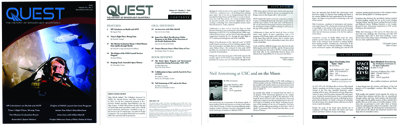
Review by Christopher Gainor, Editor of Quest
Quest, v. 33, No. 2, pp. 59-60, 2026
Quest is the history of spaceflight quarterly
Neil Armstrong, the Commander of the historic Apollo 11 lunar landing and the first human to set foot on the surface of the Moon, became a NASA's astronaut following undergraduate studies at Purdue University and graduate studies at the University of Southern California (USC).
Armstrong pursued his studies at USC while working as a NASA test pilot in the late 1950 but the growing burden of his test pilot work and later duties as an astronaut prevented him from writing the thesis required for his masters degree prior to Apollo 11.
Six months after Apollo 11 returned from the Moon on 22 January 1970, Armstrong appeared on the campus of USC in Los Angeles to speak at the dedication of the Frank R. Seaver Science Center. Later that day, Armstrong addressed a seminar at the Bovard Auditorium on the technical aspects of landing on the Moon, including descriptions of his landing on the Sea of Tranquility with Buzz Aldrin, and the subsequent landing in November 1969 of Apollo 12 astronauts Pete Conrad and Alan Bean on the Ocean of Storms.
Since the university had decided that Armstrong's work that led to Apollo 11's historic lunar landing and report at the seminar fulfilled the final requirements for his master's degree, the degree was presented to Armstrong at the end of the seminar.
Mike Gruntman, a professor of astronautics and aeronautical engineering at USC who has also written on the history of spaceflight is the author of this account of Armstrong's studies at USC. Most of this book deals with the national effort that led American astronauts to be the first explorers of the Moon.
Gruntman's account of Apollo differs from the many popular accounts that are widely available. He focuses on many of the technical issues involved in making Apollo's lunar landing possible, including the construction of the Lunar Module and overcoming challenges, including the ascent and descent engines, the landing gear, and the LM computer, paying special attention to the computer alarms that arose during Apollo 11's landing sequence.
Gruntman also discusses the specialized training required for lunar landing, notably the use of the Lunar Landing Training Vehicle, and the Lunar Landing Research Facility and Reduced Gravity Walking Simulator at the Langley Research Center. Armstrong's commentary at USC on the landing are also summarized.
While Neil Armstrong at USC and on the Moon does not deal with every challenge that Armstrong and other LM commanders dealt with in their lunar landings, it does discuss many of the unique aspects of landing on the Moon that are rarely explained elsewhere.

Appendix C
List of Figures (abridged captions)
Fig. 1.1. Grumman-built F9F Panthers in 1950
Fig. 1.2. NACA’s High Speed Flight Station at Edwards Air Force Base
Fig. 1.3. Hypersonic research rocket plane X-15 built by North American
Aviation
Fig. 1.4. Modified B-52 with X-15 rocket plane and X-15 release
Fig. 1.5. Neil Armstrong and X-15 plane
Fig. 1.6. X-15 accident on November 9, 1962
Fig. 2.1. Astronaut Neil Armstrong, Mrs. Blanche Seaver, and USC President
Norman Topping on USC campus on January 22, 1970
Fig. 2.2. Neal Armstrong at dedication of Frank R. Seaver Science Center
Fig. 2.3. Seaver Science Center in 2023
Fig. 2.4. Neal Armstrong on USC campus on January 22, 1970
Fig. 3.1. Saturn V of Apollo 11 at Launch Complex 39A on May 20, 1969
Fig. 3.2. President John F. Kennedy with NASA Administrator James T.
Webb at Cape Canaveral on November 16, 1963
Fig. 3.3. President Richard M. Nixon with NASA Administrator Thomas
Paine waiting for Apollo 11 splashdown on July 24, 1969
Fig. 3.4. NASA’s Charles Mathews, Wernher von Braun, George Mueller,
and Samuel Phillips at Kennedy Space Center on July 16, 1969
Fig. 3.5. NASA’s Rocco Petrone, Dale D. Myers, and George M. Low
Fig. 3.6. Mission Operations Control Room at Manned Spacecraft Center in
Houston, Texas
Fig. 3.7. Robert R. Gilruth and Christopher C. Kraft in 1968
Fig. 3.8. President John F. Kennedy with Wernher von Braun in 1963 and
von Braun at Launch Complex 39A on July 1, 1969
Fig. 3.9. Eberhard Rees
Fig. 3.10. Kurt H. Debus
Fig. 4.1. Launch of Apollo 11 by Saturn V on July 16, 1969
Fig. 4.2. Instrument Unit of Saturn V
Fig. 4.3. Command and Service Module and Lunar Module
Fig. 4.4. George Low and Wernher von Braun in 1971
Fig. 4.5. Command Module and Service Module of Apollo 11
Fig. 4.6. Command and Service Module of Apollo 11
Fig. 4.7. Transposition, Docking, and Extraction maneuver
Fig. 4.8. Lunar Module attached to Saturn V's third stage on Apollo 9 mission
Fig. 4.9. Joint CSM/LM vehicle orbiting the moon
Fig. 4.10. Apollo 15's CSM in 1971 and Apollo 11's LM Eagle before landing
on the moon in 1969
Fig. 4.11. Apollo 11 astronauts Michael Collins, Neil A. Armstrong, and
Edwin E. "Buzz" Aldrin Jr. in June 1969
Fig. 4.12. Chief astronaut Deke Slayton and Apollo 11 astronaut Michael
Collins on July 9, 1969
Fig. 5.1. Schematic of Lunar Module
Fig. 5.2. Lunar Module Eagle of Apollo 11 on the moon on July 20, 1969
Fig. 5.3. Orbiting Astronomical Observatory spacecraft, OAO-1, in dustfree
plastic tent
Fig. 5.4. Joseph Gavin of Grumman Aircraft Engineering Corp. and NASA
Administrator James Webb
Fig. 5.5. Advertised scientific and engineering jobs in space-related fields at
Grumman Aircraft, Westinghouse, and Eagle-Picher
Fig. 5.6. Grumman Aircraft's Thomas Kelly
Fig. 5.7. Advertised engineering jobs at Marquardt
Fig. 5.8. Descent and ascent rocket engines of Lunar Modules
Fig. 5.9. Ascent stage of Apollo 11's Lunar Module at Grumman
Fig. 5.10. Mockups of competing descent engines by Rocketdyne and
STL/TRW in 1964
Fig. 5.11. Descent stage of Lunar Module LM-9 at Grumman
Fig. 5.12. Stowed and deployed positions of Lunar Module’s landing gear
Fig. 5.13. Chris Kraft, Gordon Cooper Jr., and Robert Gilruth in 1965
Fig. 5.14. Joe Gavin with a visitor and Wernher von Braun
Fig. 5.15. Damaged Service Module of Apollo 13 after its separation from
CSM/LM on April 17, 1970
Fig. 5.16. Schematic of Command and Service Module
Fig. 5.17. Lunar Module at Grumman's Plant 5 in Bethpage
Fig. 5.18. Evolution of masses of Command and Service Modules, Lunar
Modules, Launch Escape Systems, and Spacecraft – Lunar Module
Adapters
Fig. 6.1. Lunar Landing Research Vehicle LLRV-1 in flight in 1964
Fig. 6.2. Lunar Landing Research Vehicle LLRV-1 in flight over Edwards
Air Force Base in 1965
Fig. 6.3. Neil Armstrong’s accident and ejection during LLRV flight on May 6, 1968
Fig. 6.4. Neil Armstrong parachuting after ejection during LLRV flight on May 6, 1968
Fig. 6.5. Neil Armstrong flying Lunar Landing Training Vehicle LLTV on June 16, 1969
Fig. 6.6. Neil Armstrong in Apollo Lunar Module Mission Simulator
Fig. 6.7. Lunar Landing Research Facility at Langley Research Center
Fig. 6.8. Suspended test subject for simulation of reduced gravitational pull
Fig. 6.9. Suited test subject in Reduced Gravity Walking Simulator at Langley
Research Center
Fig. 7.1. Three-phase powered descent of Lunar Module of Apollo 11
Fig. 7.2. Mission Operations Control Room at MSC during Apollo 11 on July 20, 1969
Fig. 7.3. Apollo 11 Flight Directors Cliff Charlesworth, Gerry Griffin, Gene
Kranz, and Glynn Lunney
Fig. 7.4. Apollo 11 CapComs Charles Duke Jr., James Lovell Jr., and Fred
Haise Jr. during lunar landing of Apollo 11 on July 20, 1969
Fig. 7.5. Apollo 11's Lunar Module Eagle in the Sea of Tranquility
Fig. 7.6. Julius Caesar quadrangle on the moon (lunar map sector LM 60)
Fig. 7.7. Map of Apollo 11 landing site at Mare Tranquillitatis
Fig. 7.8. Lunar Reconnaissance Orbiter photograph of Apollo 11's Eagle landing area
Fig. 7.9. Lunar Reconnaissance Orbiter photographs of Apollo 11's Eagle landing area
Fig. 7.10. Heart rate of Neil Armstrong during lunar descent and landing
Fig. 7.11. Front hatch of Lunar Module of Apollo 11
Fig. 7.12. Neil Armstrong descends the ladder of the Lunar Module on July 20, 1969
Fig. 7.13. Tranquility Base, Crater Armstrong, Crater Aldrin, Crater Collins,
landing site of Surveyor 5, and impact point of Ranger VIII on Julius Caesar Sector map
Fig. 7.14. Lunar Module LM-13 at the Cradle of Aviation Museum
Fig. 8.1. Bovard Administration Building on USC campus
Fig. 8.2. Cover and table of contents page of the March 1970 issue of USC Engineer
Fig. 8.3. Neil Armstrong's article in the March 1970 issue of USC Engineer
Fig. 8.4. Neal Armstrong at Bovard Auditorium on January 22, 1970
Fig. 8.5. Armstrong and Aldrin planting the U.S. flag on the moon
Fig. 8.6. Flag of the United States on the moon
Fig. 8.7. Astronaut Neil A. Armstrong, Dean of Engineering Zohrab A.
Kaprielian, Provost John R. Hubbard at Bovard Auditorium
Fig. 8.8. Astronaut Armstrong with his Master’s degree diploma, Provost
Hubbard, and Dean Kaprielian on January 22, 1970
Fig. 8.9. Diploma of Master of Science in Aerospace Engineering conferred
on Neil Alden Armstrong, B.S. (A.E.)
Fig. 9.1. Neil Armstrong before boarding Apollo 11 on July 16, 1969
Fig. 9.2. Statue of Neil Armstrong by sculptor Jon Hair on USC campus
It is time to build a space-based missile defense layer (op-ed)
|
|
|