
 –
Mike's books
–
Mike's books
astronauticsnow.com/mfti/
Mike's space and rocket videos –
–
Mike's books
MFTI – Moscow Physical-Technical Institute
Fiztekh. Fiztech. Phystech. MIPT.
Moscow Institute of Physics and Technology
MFTI – Moscow Physical-Technical Institute
Fiztekh. Fiztech. Phystech. MIPT.
Moscow Institute of Physics and Technology
Excerpts from
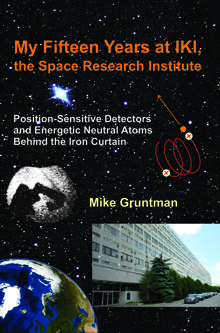
My Fifteen Years at IKI, the Space Research Institute:
Position-Sensitive Detectors and Energetic Neutral Atoms Behind the Iron Curtain
Interstellar Trail Press, 2022. ISBN 979-8985668704
detailed book content paperback Kindle book preview
Chapter 1. From Fiztekh to IKI
Fateful telephone call (pp. 1,2)
The Russian abbreviations FAKI and MFTI [Moscow Physical-Technical Institute] stood for the names of my faculty and institute, respectively. People commonly called the latter Fiztekh. (Today the institute's name is often rendered in English as the Moscow Institute of Physics and Technology or MIPT.) Arguably the most elite school in physics and applied physics in the Soviet Union, Fiztekh boasted exceptionally difficult and competitive entrance examinations.
The institute graduated half a thousand physicists each year who went to work in leading research and development organizations of the Academy of Sciences and industry. Many specialized in areas of importance for defense programs. World-class Soviet physicists taught and mentored MFTI students.
Studying in Fiztekh was particularly challenging. In their secondary school years, many incoming freshmen won national, regional, and local competitions, known as "olympiads," in science and mathematics. (Secondary schools usually combined the primary, middle, and high school levels common in the United States.) Some studied in magnet-type schools with a focus on natural sciences. Quite a few students had spent one or two years in science boarding schools, one in Moscow and the other in Akademgorodok near Novosibirsk, established for specially gifted boys and girls.
<snip>
Fiztekh and Fiztekh system (pp. 6ff)
<snip>
Bachelor of science degrees did not exist in the Soviet Union. After five or five and a half years of studies in universities or institutes, students received degrees equivalent to those of a master of science. Higher education in technical fields concentrated in specialized institutes rather than in universities that typically had programs in natural sciences but no engineering schools.
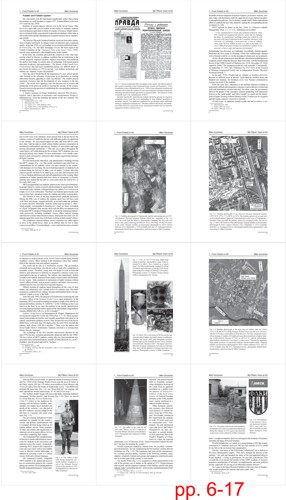
The Moscow Physical-Technical Institute stood out from other institutions of higher learning by its unique system of education and exceptional quality. In the late 1930s, several leading Soviet scientists published a letter [3] in Pravda (Fig. 1.4). The daily newspaper Pravda, the main organ of the Central Committee of the Communist Party of the Soviet Union, CPSU, was the most authoritative official publication in the country.
In the letter, the scientists advocated the creation of a new elite engineering school in Moscow to address a problem that no institutions in the country prepared "engineer scientists, engineer researchers, who combined the perfect knowledge in certain areas of technology with broad general education in physics and mathematics." The history of the French École Polytechnique that had been "established during very difficult times" of the French Revolution in 1794 to provide "real military technology and military art" inspired, in part, the proposal.[4]
After the end of World War II, the importance of a new school specifically focused on the education of physicists as an alternative to existing universities became appealing to many top officials.[5] The country poured enormous resources into the development of new weapons in the late 1940s.[6] The recent war experience and "the obvious role of science and technology in the post-war world in assuring the security of the country forced to return to the question of establishing the corresponding institution of higher learning."[7]
<snip>
In the early 1970s, Fiztekh had six schools, or faculties (fakul’tet), focused on different areas of physics. Each fakul'tet enrolled about one hundred new students, the freshmen, every year. Females constituted on average one-tenth of the students.
From the early days, admission to the institute required excelling in particularly difficult and competitive entrance exams in physics (written and oral) and mathematics (written and oral). For many years, the government allowed the pupils of the secondary schools graduating with distinction (known as the "gold medal" and "silver medal") to enroll into the institutions of higher learning without entrance exams. Fiztekh was an exception and did require entrance exams for everybody.
At each exam, an applicant earned a grade and had to achieve a certain overall score to be admitted. Some passed (that is did not fail at) the entrance exams at Fiztekh but did not earn sufficient grades for admission to the institute. Per government-approved rules and from MFTI’s early days, they "had the right to enroll without further entrance examination to mechanical-mathematical and physics faculties of universities and engineering educational institutions."[11] This rule was in place throughout the entire history of Fiztekh during the Soviet times. MFTI students who were dismissed during their studies for poor performance were usually transferred to and welcomed by numerous other leading engineering institutes of higher learning.
MFTI assigned third-year students, juniors in the American terminology, to groups linked to various research and development organizations. Such an external center, institute, or design bureau was called a base institution or simply a base (baza in Russian). The third-year students spent one day each week at their base, attending lectures by leading specialists working there. The fraction of time at the base organizations gradually increased.
During the fifth year of studies, the students spent four full days each week there and already engaged primarily in research under the guidance of science advisors. Informally, students called such an advisor a "shef," which roughly corresponded in meaning to a "chief" or "boss" in English or "el jefe" in Spanish. Only one day each week the fifth-year students went to the main MFTI campus in Dolgoprudny to attend the remaining institutewide coursework, including mandatory reserve officer military training and Marxist-Leninist indoctrination classes. During the last sixth year, the students spent their entire time at the bases working on their master’s theses.
The compulsory national military service required every male subject to serve in the armed forces either as an enlisted man for two or three years or as an officer. Correspondingly, a man could not become a scientist or engineer or medical doctor in the Soviet Union without going through mandatory reserve officer training at the institutions where they studied. Half of the institutes had such military programs.
One could not be idle in a totalitarian country. The government criminally persecuted those who did not work or study after completion of secondary school. Therefore, young men who began to work or tried and failed to gain admission to institutes in competitive entrance exams were conscripted at the age of eighteen. The military also immediately drafted as soldiers the students dismissed from studies in universities and institutes for any reason. Male graduates of institutions of higher learning without reserve officer training, such as actors, teachers, and artists, also served as enlisted men for one year after receiving their degrees.
Military training of students lasted throughout all the years of their studies and culminated with a month or two in a military unit. This latter assignment combined basic military training and familiarization with specialized weapon systems in the field.
Since the early 1960s, the program in Fiztekh led to conferring the rank of reserve officer in the Strategic Rocket Forces upon graduation. In the beginning, MFTI received for training on campus a couple of the first Soviet operational ballistic missiles, R-2 (8Zh38), [12] or SS-2 (Sibling) as they were known in the West. In my time, the students of my faculty specialized in servicing liquid-propellant rocket engines of the intermediate-range ballistic missiles (IRBM) 8K63 (R-12), or SS-4 (Sandal). [13]
Yuzhnoe Design Bureau in Dnepropetrovsk (Dnipro, Dnipropetrovsk) in Ukraine developed SS-4 in the late 1950s (Figs. 1.7, 1.8). These nucleararmed mass-produced missiles used storable propellants and relied on an entirely autonomous guidance system. They became the core of the Soviet IRBM force, with more than 550 deployed by the mid-1960s. In total, the industry built almost 2300 SS-4 missiles. [14] These were the rockets that Soviet leader Nikita S. Khrushchev famously referred to as coming from factory lines as "sausages."
The technology of the SS-4 missiles had become obsolete by the mid-1970s but they remained operationally deployed until the late 1980s. The next cohort of MFTI students coming after my class learned the new generation intercontinental ballistic missiles (ICBM) 8K64 (R-16), or SS-7 (Saddler), also designed and built by Yuzhnoe.
After the fifth year at Fiztekh, we spent one month of training in military unit No. 35600 of the Strategic Rocket Forces near the town of Ostrov in the Pskov region, 600 km (370 miles) west-northwest from Moscow and 30 km (20 miles) from the border of modern-day Latvia. This IRBM unit included the main base (Fig. 1.9), one "fixed field site" for training, and three operational missile launch areas, 10, 18, and 29 km away. [15]
Our "military month" began with close-order drills, marching in platoon formations, "kitchen patrols," and firearms (Fig. 1.10). Then, we moved to a fixed field site, Beryoza (birch tree), 4 km (2.5 miles) to the northwest for training with the ballistic missiles. Interestingly, our studies never included any details of the warhead. I saw this part of the SS-4 without a nuclear charge for the first time in a museum only many years later (Fig. 1.11).
The government considered Fiztekh graduates so valuable for the country's science and defense establishments that it exempted all from being called up for regular military service. Many graduates of other universities and engineering institutions served as junior officers for two years after completing their studies.
The Communist Party mandated annual Marxist-Leninist indoctrination coursework for students in all universities and institutes across the country. Incidentally, achieving Ph.D. degrees also required an extra one-year course and an unavoidable exam in Marxist-Leninist philosophy, in addition to screening exams in a chosen science field and a foreign language.
The communist country compelled MFTI students to do manual physical labor on construction projects for a month during one summer. Soviet propaganda habitually denigrated bourgeois "rotten intelligentsia" and praised manual labor as ostensibly strengthening ideological bearings of the youth. Such an approach resembled on a smaller scale the practice of Reichsarbeitsdienst, or the Reich Labor Service, in National-Socialist Germany in the 1930s, another sister regime anchored in a radical socialist ideology.
Other European communist countries also followed such practices to various degrees. In the late 1950s, Hungary, for example, introduced the requirement for students to work 20 hours each year on construction sites. [16] Fortunately, the early ideological vigor and fervor had largely dissipated by my time, giving place to corrupt atrophy in such endeavors. Not in the People's Republic of China, however, where the ongoing enthusiastic wave of atrocities of the "Great Proletarian Cultural Revolution" has been devastating the country. [17]
Fiztekh organized compulsory manual work, the so-called "constructions detachments," for one month during the first summer vacation after the freshman year (Fig. 1.12). The experience had some useful consequences. In a common practice during vacations in the following summers, many students voluntarily formed such groups and engaged in construction projects in remote parts of the country to earn money.
<snip>
My faculty, FAKI (Fig. 1.13), assigned us to base organizations at the end of the second year of studies in the spring of 1973. Design bureaus and research and development institutes of the ballistic missile and space industry had a "controlling interest" of the faculty and dominated the FAKI bases. A couple of institutes, however, belonged to the Academy of Sciences, including the Space Research Institute [IKI].
Fiztekh included me, as I asked, in a group heading to IKI that usually consisted of 5-7 students each year. The new fall semester of 1973 would be our first in the mysterious base organization.
<snip>
Our student life in the Space Research Institute began with specialized courses taught by IKI staff scientists. Research under the guidance of science advisors followed. The courses gave us unique opportunities to meet the country’s leading space specialists and learn about some of the institute's programs. Several instructors were deputy directors and heads of research departments and laboratories. Knowing these accomplished and influential specialists personally made access to them easier in the future. Teaching responsibilities did not particularly burden IKI scientists and provided them with excellent additional earnings.
Administratively, MFTI set up a kafedra of space physics at IKI. In the Soviet Union, a kafedra (from the Greek καθεδρα, or a seat) was equivalent in scope to a specialty within an academic department of an American university but often with a larger number of instructors. It had its own chairperson and faculty. While the space physics kafedra formally belonged to MFTI, its faculty members worked full-time as staff members at IKI. They taught specialized courses typically once a year and oversaw student research in addition to their "day jobs." The arrangement resembled in some respect adjunct faculty in U.S. universities.
Incidentally, the concept of tenure for faculty in universities and institutes did not and could not exist in communist countries. Academic freedom and consistently implemented socialism are fundamentally incompatible. Ironically, this rude awakening will welcome the present-day proponents of socialism in American universities if they ever succeed politically. It will be too late for them, though.
<snip>
In 1976, MFTI expanded by adding a new Faculty of Problems of Physics and Energetics (Fakul’tet Problem Fiziki i Energetiki, or FPFE). This new faculty administratively took over the kafedra of space physics and IKI as one of its base institutes. A celebratory ceremony of a formal opening of FPFE took place in a "glassy house" (Fig. 1.18) next to the IKI backyard in February 1977. Attending dignitaries (Fig. 1.24) included two Nobel prize winners in physics, Aleksandr (Alexander) Prokhorov (1964) and Petr Kapitsa (he would receive his Nobel prize the next year for the discovery of superfluidity of liquid helium in the late 1930s).
We graduated in a mere few months. My group became the last cohort of MFTI students at the Space Research Institute with degrees from FAKI. Henceforth, Fiztekh students studying at IKI would graduate from the FPFE faculty.
<snip>
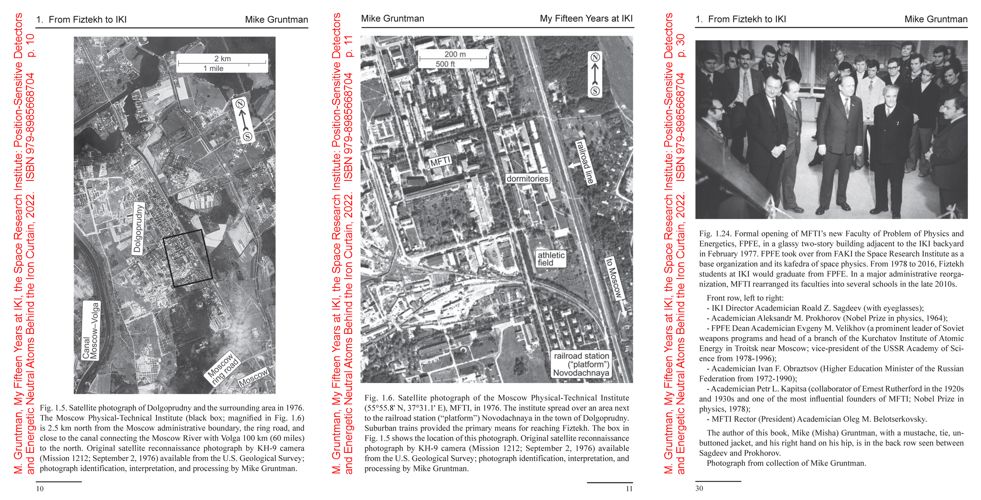
Fig. 1.5. Satellite photograph of Dolgoprudny and the surrounding area in 1976. The Moscow Physical-Technical Institute (black box; magnified in Fig. 1.6) is 2.5 km north from the Moscow administrative boundary, the ring road, and close to the canal connecting the Moscow River with Volga 100 km (60 miles) to the north. Original satellite reconnaissance photograph by KH-9 camera (Mission 1212; September 2, 1976) available from the U.S. Geological Survey; photograph identification, interpretation, and processing by Mike Gruntman.
Fig. 1.6. Satellite photograph of the Moscow Physical-Technical Institute (55°55.8' N, 37°31.1' E), MFTI, in 1976. The institute spread over an area next to the railroad station ("platform") Novodachnaya in the town of Dolgoprudny. Suburban trains provided the primary means for reaching Fiztekh. The box in Fig. 1.5 shows the location of this photograph. Original satellite reconnaissance photograph by KH-9 camera (Mission 1212; September 2, 1976) available from the U.S. Geological Survey; photograph identification, interpretation, and processing by Mike Gruntman.
Fig. 1.24. Formal opening of MFTI's new Faculty of Problem of Physics and Energetics, FPFE, in a glassy two-story building adjacent to the IKI backyard in February 1977. FPFE took over from FAKI the Space Research Institute as a base organization and its kafedra of space physics. From 1978 to 2016, Fiztekh students at IKI would graduate from FPFE. In a major administrative reorganization, MFTI rearranged its faculties into several schools in the late 2010s.
Front row, left to right:
– IKI Director Academician Roald Z. Sagdeev (with eyeglasses);
– Academician Aleksandr M. Prokhorov (Nobel Prize in physics, 1964);
– FPFE Dean Academician Evgeny M. Velikhov (a prominent leader of Soviet
weapons programs and head of a branch of the Kurchatov Institute of Atomic
Energy in Troitsk near Moscow; vice-president of the USSR Academy of Science
from 1978-1996);
– Academician Ivan F. Obraztsov (Higher Education Minister of the Russian
Federation from 1972-1990);
– Academician Petr L. Kapitsa (collaborator of Ernest Rutherford in the 1920s
and 1930s and one of the most influential founders of MFTI; Nobel Prize in
physics, 1978);
– MFTI Rector (President) Academician Oleg M. Belotserkovsky.
The author of this book, Mike (Misha) Gruntman, with a mustache, tie, unbuttoned jacket, and his right hand on his hip, is in the back row seen between Sagdeev and Prokhorov.
Photograph from collection of Mike Gruntman.
Sputnik Explorer Vanguard Astronautics Missile defense Baikonur Tyuratam Saryshagan Rocket equation Rocket espionage U-2 Neil Armstrong USC
Mike's books
–
Mike's space and rocket videos –
Make the world a better place