
 –
Mike's books
–
Mike's books
astronauticsnow.com/mfti/
Mike's space and rocket videos –
–
Mike's books
Surface conversion to negative ions
Low-energy ENAs. Interstellar gas in LISM.
Surface conversion to negative ions
Low-energy ENAs. Interstellar gas in LISM.
Excerpts from
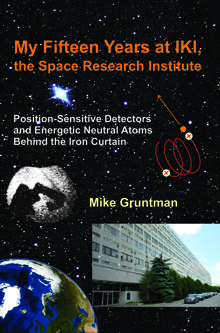
My Fifteen Years at IKI, the Space Research Institute:
Position-Sensitive Detectors and Energetic Neutral Atoms Behind the Iron Curtain
Interstellar Trail Press, 2022. ISBN 979-8985668704
detailed book content paperback Kindle book preview
Chapter 7. Energetic Neutral Atoms
<snip>
Detecting neutral atoms directly (pp. 161, 162)
There was also another important family of non-thermal, energetic neutral atoms with energies under 40 eV. Such energies were too low for penetrating the foils and for efficient secondary emissions. These atoms were primarily represented by interstellar hydrogen and traces of deuterium flying into the solar system from the LISM and filling interplanetary space.
Interstellar oxygen atoms also fell into this category of particles with similar energies per nucleon and with large electron affinities. The latter meant that they could form negative ions. (Note that negative ions of helium cannot exist in a stable form.) Labeled as "low-energy ENAs," these atoms required physically different approaches for detection. Atoms with such energies per nucleon should also originate in planetary ionospheres and one would encounter them in cometary flybys.
<snip>
Surface conversion to negative ions (pp. 165-167)
Low-energy ENAs with energies in the 1-40 eV/nucleon range required a physically different approach for their detection. Advances in generating high-intensity high-energy neutral atom beams for fusion plasma energy pumping and futuristic space weapons suggested a possible technology: surface conversion to negative ions. There were also independent proposals, unrealized at that time, to use this physical effect for corpuscular diagnostics of fusion plasmas. The surface conversion approach particularly suited the direct detection of interstellar hydrogen, deuterium, and oxygen atoms entering the solar system from the LISM. [20 (pdf-1, pdf-2, pdf-3)]
I could not explore atom conversion to negative ions in the laboratory in the 1970s and 1980s. While it was clear how to do it, there were simply no funds, support, time, and other indispensable resources to build a dedicated experimental setup with an ultra-high clean vacuum and a well-characterized source of collimated monoenergetic low-energy neutral atoms. I could only follow the physics literature on the subject. We briefly described the promise of this detection technique in a publication in 1983. [21]
After reaching California in March 1990, I outlined this enabling concept first in USC technical reports in October 1990 and February 1991. [22] In August 1991, I led a team as a principal investigator (with coinvestigators from USC, University of Arizona, Stevens Institute of Technology, and Jet Propulsion Laboratory) that submitted a comprehensive proposal (nearly $800k in current dollars) to NASA: "In situ measurement of low-intensity and low-energy neutral atom fluxes in the solar system." The concept called for an in-depth experimental study of the underlying physics.
We presented the surface conversion technique, based on the proposal, at the annual Fall Meeting of the American Geophysical Union (AGU) in December 1991 and then at the World Space Congress in Washington, DC, in the summer of 1992. [23 (pdf)] The proposal to NASA was not funded.
In the mid-1991, the editor of the Journal of Geophysical Research—Space Physics, or JGR, Christoph Goertz, agreed to accept for consideration my manuscript with a detailed feasibility study of this novel instrumentation concept, although JGR at that time avoided instrumentation-focused topics. Only one week after our last telephone conversation, a disgruntled student shot Chris dead at the University of Iowa campus in a well-known tragic event on November 1, 1991. Jim Van Allen stepped in temporarily as the journal editor and confirmed Chris’s commitment.
The article manuscript was ready in a few months. Jim told me that he would be stepping down soon and asked to discuss the arrangement with the new forthcoming editor. The latter declined to consider the feasibilitystudy- type article for publication. From the spring of 1992, I circulated the original manuscript intended for JGR among several colleagues, particularly those working on a Small Explorer proposal "HI-LITE," who were interested in the detection of neutral atom fluxes. [24]
After some delay, this article [25 (pdf)] describing in detail the surface conversion technique appeared in another journal, Planetary and Space Science, in 1993. Then Advances in Space Research also published another [26 (pdf)] of my articles that was based on a talk on the same subject given earlier at the World Space Congress in 1992.
Nobody has a monopoly on ideas for solutions to outstanding problems. After learning about my work on conversion to negative ions, a colleague at the University of Bern, Peter Wurz, wrote me in January 1993 that because of his "background in surface science" he had independently identified sometime in 1992 negative surface ionization as “the method of choice” for direct detection of low-energy neutrals. [27] It was natural that other scientists came to similar ideas, indirectly validating the new concept. The time for the technique had arrived.
My follow-on attempts to obtain funding for an experimental program to implement ENA surface conversion to negative ions did not succeed. Others would build the space instruments. Nevertheless, I was glad to publish a detailed feasibility study that helped others advance the method and avoid, as I hoped, missteps in its development and implementation. Space instruments based on the surface conversion to negative ions, first conceived at IKI in the late 1970s, flew later on NASA’s space missions IMAGE (LENA) and IBEX (IBEX-Lo) and are planned for future experiments.
Sputnik Explorer Vanguard Astronautics Missile defense Baikonur Tyuratam Saryshagan Rocket equation Rocket espionage U-2 Neil Armstrong USC
Mike's books
–
Mike's space and rocket videos –
Make the world a better place