
 –
Mike's books
–
Mike's books
astronauticsnow.com/podlipki/
Mike's space and rocket videos –
–
Mike's books
Podlipki (Kaliningrad, Korolev)
Ballistic missile and space establishment
Podlipki (Kaliningrad, Korolev)
Ballistic missile and space establishment
Excerpts from

Blazing the Trail
The Early History of Spacecraft and Rocketry
AIAA, Reston, Va., 2004. ISBN 978-1563477058
detailed book content hardcover book preview
Chapter 13
Road to Sputnik (excerpts, pp. 279-283)
Two areas in the immediate vicinity of Moscow, Khimki and Podlipki, have emerged as the major centers of the Soviet rocket and space establishment ...
<snip>
The other area on the Moscow outskirts, Podlipki, has grown to a special prominence in Soviet rocket development. (The word Podlipki literally means under the linden trees in Russian.) Podlipki was about 15 miles (25 km) north-northeast from the Moscow downtown. Within a few years, it became the area of the highest concentration of the Soviet rocket and space establishment.

The Decree of 13 May 1946 established a new secret rocket research center, Scientific Research Institute N.88, or NII-88, about 2.5 km (1.5 miles) from the suburban railroad station Podlipki. Sergei Korolev was appointed the chief designer of long-range rockets at NII-88. Korolev's group was reorganized into a Special Design Bureau N.1 (OKB-1) of NII-88 in 1950. NII-88 was subsequently renamed the Central Scientific Research Institute of Machine Building, or TsNIIMash. TsNIIMash became the leading Soviet research and certification institution in rocket and space technology. It is also a home of the Russian, former Soviet, spaceflight control center (Tsentr Upravleniya Polyotami, or TsUP)
Text box: U-2 OVER PODLIPKI AND KHIMKI
The second photoreconnaissance overflight of the Soviet Union by the U-2 aircraft took place on 5 July 1956. This was the only U-2 mission that flew over Moscow. Glushko's rocket engine plant in Khimki and Korolev's rocket development center in Podlipki were among the mission primary targets. Both locations were covered by clouds, and no photographs were taken.
Korolev's design bureau became independent of NII-88 in 1956 when his OKB-1 was combined with the nearby Plant N.88 to form the Experimental Design Bureau N.1. After Korolev's death in 1966 the bureau was renamed the Central Design Bureau of Experimental Machine Building, or TsKBEM. Today, it is known as the Rocket Space Corporation Energia (RKK Energia).
Text box: SCALE OF THE KOROLEV'S ROCKET PLANT
Andrei D. Sakharov, one of the leading creators—"fathers"—of the Soviet thermonuclear weapons, wrote in his memoirs about a trip in 1953 "through a ballistic missile plant where I met Sergei Korolev, the chief designer, for the first time. We [in the nuclear weapons program] had always thought our own work was conducted on a grand scale, but this was something of a different order. I was struck by the level of technical culture: hundreds of highly skilled professionals coordinated their work on the fantastic objects they were producing, all in a quite matter-of-fact, efficient manner"(Sakharov 1990, 177).
Several other leading rocket and space research and development centers were set up in Podlipki, some spun off NII-88. The A.M. Isaev Design Bureau of Chemical Machine Building (KB Khimmash) is located next to TsNIIMash. KB Khimmash, named after its first director Aleksei M. Isaev, was initially a part of NII-88 and became an independent developer of liquid-propellant rocket engines in 1956. Another offspring of NII-88 is the Scientific-Manufacturing Association of Measuring Techniques (NPO IT). In 1966, NPO IT separated from NII-88 as the Scientific Research Institute of Measuring Techniques (NIIT). The main military research centers of the strategic rocket forces (NII-4) and of the space forces (NII Kosmos) are only one mile away from the Podlipki station.
Text box: SCIENTISTS AND ENGINEERS FOR PODLIPKI
Leading Soviet institutions of higher learning trained scientists and engineers for Podlipki's sprawling space complex.
The Bauman Moscow Technical School (Bauman MVTU) and Moscow Aviation Institute (MAI) had the branches in Podlipki. The nearby Moscow Technical Institute of Forestry (MLTI) established special departments for training specialists in several engineering areas, particularly in electronics and control, for the space centers. A number of senior students of the elite Moscow Physical-Technical Institute (MFTI, or Fiztekh) studied directly at TsKBEM and TsNIIMash for three years before earning their Master of Science degrees and continued as staff scientists and engineers after the graduation. Many other institutions and universities, including the Moscow State University (MGU), trained specialists for Podlipki.
A town grew up in the surrounding area to house almost 200,000 inhabit-ants, with the majority employed by rocket and space establishments of Podlipki's cluster. In the Soviet times, the town was called Kaliningrad, after one of the most trusted Stalin's henchmen, Mikhail I. Kalinin. It was renamed Korolev after collapse of the communist regime in the early 1990s. The railroad station for suburban trains is still called Podlipki.
<snip>
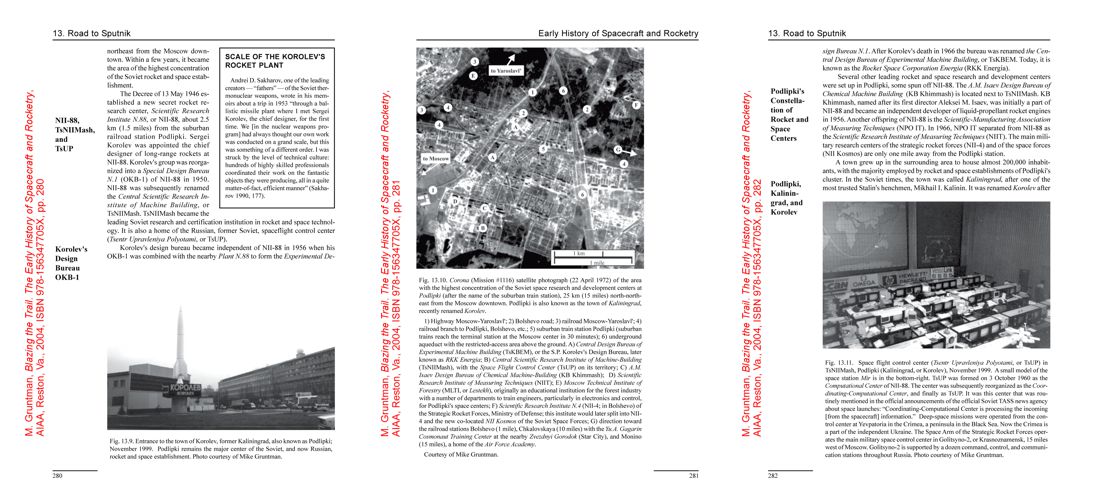
Fig. 13.9. Entrance to the town of Korolev, former Kaliningrad, also known as Podlipki; November 1999. Podlipki remains the major center of the Soviet, and now Russian, rocket and space establishment. Photo courtesy of Mike Gruntman.
Fig. 13.10. Fig. 13.10. Corona (Mission #1116) satellite photograph (22 April 1972) of the area with the highest concentration of the Soviet space research and development centers at Podlipki (after the name of the suburban train station), 25 km (15 miles) north-northeast from the Moscow downtown. Podlipki is also known as the town of Kaliningrad, recently renamed Korolev.
1) Highway Moscow-Yaroslavl'; 2) Bolshevo road; 3) railroad Moscow-Yaroslavl'; 4) railroad branch to Podlipki, Bolshevo, etc.; 5) suburban train station Podlipki (suburban trains reach the terminal station at the Moscow center in 30 minutes); 6) underground aqueduct with the restricted-access area above the ground. A) Central Design Bureau of Experimental Machine Building (TsKBEM), or the S.P. Korolev's Design Bureau, later known as RKK Energia; B) Central Scientific Research Institute of Machine-Building (TsNIIMash), with the Space Flight Control Center (TsUP) on its territory; C) A.M. Isaev Design Bureau of Chemical Machine-Building (KB Khimmash); D) Scientific Research Institute of Measuring Techniques (NIIT); E) Moscow Technical Institute of Forestry (MLTI, or Lestekh), originally an educational institution for the forest industry with a number of departments to train engineers, particularly in electronics and control, for Podlipki's space centers; F) Scientific Research Institute N.4 (NII-4; in Bolshevo) of the Strategic Rocket Forces, Ministry of Defense; this institute would later split into NII-4 and the new co-located NII Kosmos of the Soviet Space Forces; G) direction toward the railroad stations Bolshevo (1 mile), Chkalovskaya (10 miles) with the Yu.A. Gagarin Cosmonaut Training Center at the nearby Zvezdnyi Gorodok (Star City), and Monino (15 miles), a home of the Air Force Academy. Courtesy of Mike Gruntman.
Fig. 13.11. Space flight control center (Tsentr Upravleniya Polyotami, or TsUP) in TsNIIMash, Podlipki (Kaliningrad, or Korolev), November 1999. A small model of the space station Mir is in the bottom-right. TsUP was formed on 3 October 1960 as the Computational Center of NII-88. The center was subsequently reorganized as the Coordinating-Computational Center, and finally as TsUP. It was this center that was routinely mentioned in the official announcements of the official Soviet TASS news agency about space launches: "Coordinating-Computational Center is processing the incoming [from the spacecraft] information." Deep-space missions were operated from the control center at Yevpatoria in the Crimea, a peninsula in the Black Sea. Now the Crimea is a part of the independent Ukraine. The Space Arm of the Strategic Rocket Forces operates the main military space control center in Golitsyno-2, or Krasnoznamensk, 15 miles west of Moscow. Golitsyno-2 is supported by a dozen command, control, and communication stations throughout Russia. Photo courtesy of Mike Gruntman.
Sputnik Explorer Vanguard Astronautics Missile defense Baikonur Tyuratam Saryshagan Rocket equation Rocket espionage U-2 Neil Armstrong USC
Mike's books
–
Mike's space and rocket videos –
Make the world a better place