–
Mike's books
–
Mike's books
astronauticsnow.com/ENA/
Mike's space and rocket videos –
–
Mike's books
Energetic Neutral Atoms (ENAs) in Space
ENA Imaging of Space Plasmas
invited talk (15 min.) at the Fall Meeting, AGU, December 2012
Energetic Neutral Atom Imaging: The Next Step
–

Energetic neutral atom imaging of space plasma (review)
(pdf)
by Mike Gruntman in Review of Scientific Instruments, 1997
Energetic Neutral Atoms
Excerpts from
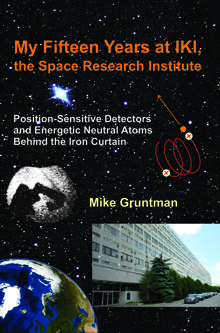
My Fifteen Years at IKI, the Space Research Institute:
Position-Sensitive Detectors and Energetic Neutral Atoms Behind the Iron Curtain
Interstellar Trail Press, 2022. ISBN 979-8985668704
detailed book content paperback Kindle book preview
Chapter 7. Energetic Neutral Atoms (pp. 153ff)
Birth of ENAs

Local, in situ, direct detection of individual neutral atoms in interplanetary space looked unrealistic for decades. Mass spectrometers have been measuring neutral atoms and molecules in the upper atmosphere of the Earth since the 1950s. Such instrumentation could probe, in situ, relatively large number densities in planetary environments. Optical sensors also detected solar ultraviolet and extreme ultraviolet photons scattered by atoms in interplanetary space. These observations were, however, essentially non-local, line-of-sight, and limited in sensitivity.
Charged particles (ions) and neutral particles collide in space plasmas. Then, an exchange of charge sometimes occurs when an electron jumps from one particle to another. The process is known as charge exchange. Whenever an energetic ion undergoes a charge exchange collision with a neutral background atom, the ion becomes an energetic neutral atom (Fig. 7.1). Planetary atmospheres and interstellar gas that fills interplanetary space provide neutral atoms for energetic ions to become neutral. Consequently, such collisions create ENAs everywhere. The number densities of ENAs are exceptionally low and their fluxes are usually weak.
Magnetic fields permeate space, whether near planets (forming magnetospheres) or in interplanetary and interstellar space. Energetic ions cannot travel across magnetic field lines. The field bends ion trajectories by the Lorentz force and causes them to gyrate (Fig. 7.2). Therefore, the magnetic field confines the ions and prevents them from reaching a remote observer. Consequently, one cannot directly examine the properties of ions in, for example, a magnetosphere from a distance.
In contrast to ions, a unique feature of ENAs is that magnetic fields do not exert forces on neutral atoms. Therefore, the newly born ENAs fly across magnetic field lines along straight trajectories (Fig. 7.2) until lost due to ionization. They could cover large distances in space. The gravitational field of the Sun and planets may bend ENA trajectories, but this effect is often small and can be accounted for.
An observer can thus measure ENA fluxes produced by ions in remote plasmas at large distances. Obtaining an image of a space plasma object such as a planetary magnetosphere (Fig. 7.3) or the interstellar boundary of the solar system in emitted ENA fluxes became known as ENA imaging. Scientifically inclined readers can find physics details of the concept and instrumentation in a review article in a physics journal. [1]
ENA imaging of space plasmas is conceptually similar to widely used
passive corpuscular diagnostics of fusion plasmas. [2] Already in 1951, ...
<snip>
Wandering in wilderness
The presence of energetic ions and neutral gas everywhere in space
makes ENAs ubiquitous. The ideas of probing planetary magnetospheres
and the interstellar boundary of the solar system in energetic neutral atoms
originated in the early days of the space age. Scientific literature occasionally
mentioned, as a curiosity, the possibility of the existence of chargeexchange-
produced neutral atoms with energies of hundreds and even
thousands of electronvolts.
As early as 1961, ...
<snip>
Energetic neutral atoms open a way to probe remotely global ion
and plasma properties. From a distance, one could obtain an image of a
distribution of energetic ions surrounding a planet, its magnetosphere, by
detecting and identifying individual energetic neutral atoms originating
there. Figure 7.3 shows a spacecraft capturing a series of "enagraphs," as
envisioned by us in the mid-1980s, which would reveal "the time evolution
of the magnetospheric processes, for instance of the ring current decay." [8] ...
<snip>
Detecting neutral atoms directly
<snip>
Figure 7.6 shows several basic common techniques and elements
of present-day ENA instrumentation. Free-standing ultrathin carbon
foils (Fig. 7.6,a), only 10-40 atomic layers thick, had been used in nuclear
physics experiments for some time by the late 1970s. Atomic particles with
energies of several hundred electronvolts per nucleon and higher could penetrate
and fly through them. The first ENA-detection experiments on sounding
rockets in 1968 and 1970 relied on stripping neutral atoms (converting
to positive ions) passing through such foils (7.6,b), with the subsequent ion
analysis and detection. IBEX would later use this approach for mapping
the interstellar boundary in ENA fluxes. Other techniques shown in Fig. 7.6
had been used in unrelated applications under different environments and
for different energies, species, and wavelengths in nuclear physics experiments
(7.6,c), production of high-intensity negative ion beams (7.6,d), and
in “superinsulator” shields in the infrared spectral region (7.6,e). [13]
<snip>
Fig. 7.1. Charge exchange collision of an energetic (fast) ion and a background
(slow) neutral atom. A negatively charged electron e jumps from one colliding
particle (neutral atom) to another (ion). The created neutralized ion, the energetic
neutral atom or ENA, preserves the magnitude and direction of the original
velocity vector, V, of the energetic ion.
Fig. 7.2. Energetic ions gyrate in magnetic field B in space. After a charge exchange
collision, the newly created ENA preserves the velocity vector V of the
ion at the moment of the collision. It then flies away across magnetic field lines
in a straight trajectory as a stone from a sling. Consequently, one can probe the
properties of energetic ions remotely from a large distance by detecting ENAs.
Recording an image of a plasma object, such as a magnetosphere or the solar
system interstellar boundary, formed by emitted energetic neutral atoms became
known as ENA imaging.
Fig. 7.5. The Sun’s heliosphere and its galactic neighborhood. A supersonic radial
expansion (with a velocity of 500 km/s) of the solar wind ends with a termination
shock where the solar wind plasma abruptly slows down and heats up. The
heliopause (dashed line) separates the solar and interstellar plasmas and forms
the boundary of the heliosphere. The flow of interstellar plasma and neutral
gas with a velocity of 25 km/s, or 5 AU/yr, relative to the Sun, the interstellar
wind, may form a weak bow shock in front of the heliosphere. The surrounding
local interstellar medium, LISM, includes cosmic rays and carries the frozen-in
magnetic field B. Interstellar helium atoms fly into the solar system practically
unimpeded and reach Earth orbit, where they can be directly detected.
Fig. 7.6. Basic techniques and sensor components for ENA detection. (a) – ultrathin
carbon foils for detection of ENAs with energies >400 eV. (b) – ENA stripping
in thin foils with subsequent ion analysis. (c) – thin-foil-based time-of-flight ENA
detection. (d) – detection of low energy (<40 eV/nucleon) ENAs by converting
them into negative ions (left) or sputtering positive and/or negative ions from the
surface (right). (e) – filters with small holes or slits allowing passage of ENAs
and blocking background EUV and UV photons.
Imaging in Fluxes of Energetic Neutral Atoms (ENA Imaging)
A new field of space experiments and instrumentation has emerged: imaging of space plasmas
in fluxes of energetic neutral atoms (ENAs), or ENA imaging. It took over 25 years
from the first vague concepts of late 1970s to develop experimental techniques
and instrumentation. (See review of the field and development of the concept and experimental techniques and
instrumentation in a highly cited article in Review of Scientific Instruments,
1997; also as a pdf file.)
The concept of ENA imaging has spectacularly demonstrated its power on the NASA's
IMAGE mission (launched in
2000) carrying three ENA instruments for imaging magnetospheric processes in
different energy ranges. (See also
NASA's IMAGE site.) The
Cassini
spacecraft used an imaging energetic neutral atom camera (INCA) to study the
magnetosphere of Saturn. NASA mission TWINS provided for the first time
a spectroscopic view in ENAs of the terrestrial magnetosphere by simultaneous
observation from two spacecraft. A few opther space missions carried ENA instruments, e.g., ASTRID.
In 2008, NASA launched the Interstellar Boundary Explorer (IBEX) mission
to probe remotely in ENA fluxes the galactic frontier of the solar system.
The scientific rationale and experiment concept of IBEX are described in detail in an
article (pdf) in Journal of Geophysical Research, 2001.
The concept of ENA imaging the heliosphere and remotely exploring the interstellar frontier of the Solar system
first emerged in 1979-1980 (see pp. 28-29 in Preprint-825, IKI, 1983).
While the first simple dedicated space experiment (article
in Physics of the Outer Heliosphere, 1990) to detect heliospheric ENAs was developed in mid-1980s,
it has never flown.
(See details in History of ENA study in space.)
It took almost twenty years of physics research and development to refine the exprimental concept
of heliosphere ENA imaging and to develop and mature the instrumentation technology.
Energetic Neutral Atoms (ENAs) – Tutorial
The interaction between charged and neutral particles is a common phenomenon
in space plasmas. Whenever an energetic ion undergoes a charge exchange
process in a collision with a neutral background atom, an energetic
neutral atom – ENA – is born. Ion-electron recombination and neutral
atom acceleration by the solar gravitation may also contribute to an ENA
population under certain conditions. ENAs are ubiquitous in space
environment and their study opens a new window on various phenomena in
space plasmas with a promise (already partially realized) to
qualitatively improve our understanding of global magnetospheric and
heliospheric processes.
ENA measurements are a powerful tool to remotely
study various global plasma objects in space, such as the heliosphere
and planetary magnetospheres. By recording ENA fluxes as a function of
observational direction, one can reconstruct a global image of the
object of interest, thus the term "ENA imaging," first introduced in
1984 for imaging from outside and from inside of the magnetosphere.
Plasma ion energy distribution and ion composition can be remotely
established by measuring ENA energies and masses. ENA imaging usually
means not only determining ENA flux angular distribution but also ENA
energies and masses. An ENA imaging experiment ideally produces a set of
images of a plasma object in ENAs of different masses and in different
energy ranges.
Protons are the most abundant component of space
plasma ions. Unlike other space plasma ions (e.g., He+ and O+), protons
cannot be imaged optically, which makes ENAs in many cases the only tool
to study processes of interest remotely.
ENA instrumentation
ENAs remained poorly explored experimentally for many years due to enormous instrumental
difficulties. The reason is the following. The energies of ENAs (100 eV and
higher) are sufficient to produce secondary electrons on surface impact.
Therefore, ENAs can be conveniently registered by secondary electron
multipliers, such as channel electron multipliers and microchannel plate
detectors. The problem is that space is filled with fluxes of H
Lyman-α photons (λ = 121.6 nm = 1216 A) that efficiently produce photoelectrons from surfaces and
consequently trigger secondary electron multipliers.
(The other important background emission line is at λ = 58.4 nm = 584 A.)
The count rate
of a typical detector due to background photons would be 4-7 orders of
magnitude higher than the count rate due to fluxes of ENAs. Another
experimental challenge is that fluxes of ENAs are very weak and one
needs to develop instruments with large geometrical factors. The
experimental difficulties were perceived as insurmountable by many – except very few
brave souls – at that time.
Various experimental techniques and instrument
components and designs (with imaging and analyzing capabilities) have
been developed to enable ENA imaging across wide range of ENA energies,
from a few eV to 100 keV. We mention here
ENA instrumentation today is mature, with excellent performance
characteristics. See review article on ENA
space instrumentation.
Sputnik
Explorer
Vanguard
Astronautics
Missile defense
Baikonur Tyuratam
Saryshagan
Rocket equation
Rocket espionage
U-2
Neil Armstrong
USC
Selected Mike Gruntman's publications
Charge exchange
on interstellar helium dominates properties of the neutral solar
wind in the downwind (interstellar wind) hemisphere.
Dynamics
properties of the flux of interstellar helium atoms at 1 AU
Motivation for
instrumentation development for study of hot plasmas in space
(neutral solar wind component) and laboratory (fusion)
Experimental
demonstration of ultrathin-foil TOF ENA analysis and detection at
ENA energies as low as 600 eV (TOF was applied at that time for
energies >25 keV) ENA fluxes
disturb the approaching supersonic interstellar wind far beyond the
bow shock (how far one needs to go to reach pristine interstellar
medium). One of the explanations of the IBEX-discovered "ribbon" in 2009 is based
on refinement of this concept. Feasibility study
and comprehensive proposal for a space experiment to detect ENAs in
space Primary focus:
neutral component of the solar wind and heliospheric ENAs
originating at the solar system heliospheric interface (termination
shock) Description of
the built prototype of the flight space instrument to detect ENAs in
the solar wind (neutral solar wind), from the heliospheric interface
(heliosphere ENA imaging), and ENAs from magnetospheres of the
Earth, Jupiter, and Saturn Feasibility study
of ENA imaging of planetary magnetospheres Elastic
collisions of interstellar helium atoms with solar wind protons,
leading to the "growing wings" of atom angular (as in detection by
Ulysses and IBEX) distributions Experimental
demonstration of a TOF instrument arrangement to directly detect
low-energy He atoms (as interstellar helium at 1 AU) in a
noise-suppression mode Description of
the space experiment and instrument (developed and built in
mid-1980s and never flown) to measure a neutral component in the
solar wind (neutral solar wind) and heliospheric ENAs from the
heliospheric interface (heliosphere ENA imaging)
Physics of
multi-electron secondary emission (emission statistics) from thin
foils for ENA mass identification (through detector amplitude
analysis) in TOF instruments Evaluation of
various available technologies for application as diffraction
filters (ENA filters) for ENA imaging of space plasmas Prediction of
highly anisotropic fluxes of ENAs from the heliospheric
interface Comprehensive
feasibility study introduces a concept of surface conversion of ENAs
into negative ions for ENA imaging of space plasmas (as on
IMAGE-LENA) Evaluation of
coded-aperture technique for imaging of planetary magnetospheres in
ENA fluxes ENAs in the solar
wind - neutral solar wind properties New
high-throughput collimator design for ENA instruments
Evaluation of
free-standing transmission gratings for application as diffraction
filters for ENA imaging of space plasmas (used on IMAGE-MENA and
TWINS) Evaluation of
free-standing transmission gratings for application as diffraction
filters for ENA imaging of space plasmas (used on IMAGE-MENA and
TWINS) Outgassing of
interplanetary dust under solar wind bombardment
Evaluation of
free-standing transmission gratings for application as diffraction
filters for ENA imaging of space plasmas (used on IMAGE-MENA and
TWINS) Review (> 100 citations) of the
experimental techniques and instrumentation for space plasma imaging
in ENA fluxes; 505 references Modern physical
concept of heliosphere imaging in ENA fluxes (> 100 citations), a key publications,
per competition debrief, to IBEX selection by NASA Heliosphere ENA
maps highly sensitive to physically distinct scenarios of the the
interaction between the solar wind and galactic medium
Includes a
concept of an ENA experiment on Interstellar Probe
New effect:
importance of mass transport in the heliosphere by ENAs for
interplanetary neutral atom properties in the sun's vicinity (< 1 AU) Comprehensive
study of the solar system frontier by ENA imaging and EUV
mapping Concept of
mapping the heliopause in extreme ultraviolet (EUV)
Concept of
mapping the heliopause in extreme ultraviolet (EUV) Detailed
evaluation of heliopause mapping at O+ line at 83.4 nm
Detailed
evaluation of solar wind emissions at He+ line at 30.4 nm
Concept of
imaging of the three-dimensional solar wind and mapping the
heliopause at 30.4 nm Concept of
imaging of the three-dimensional solar wind and mapping the
heliopause at 30.4 nm and 83.4 nm
Mike's books
–
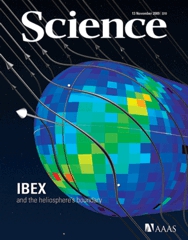

The figure also shows the positions of Voyager 1 (V1) and 2 (V2) spacecraft
at the heliocentric distances of 165 AU and 138 AU, respectively, in 2025. These
space vehicles fly away from the Sun. Voyager 1 and 2 crossed the termination
shock in 2004 and 2007 and the heliopause in 2012 and 2018, respectively.
The gray region between the termination shock and heliopause, the heliosheath,
contains the solar wind plasma heated in the shock transition. Charge exchange
collisions between hot plasma protons and inflowing interstellar hydrogen atoms
produce heliospheric energetic neutral atoms that can reach our planet Earth.
Measuring the directional intensities and energy dependencies of these heliospheric
ENAs on a spacecraft near the Earth remotely probes the heliosheath
and maps the interstellar boundary of the solar system. Development of the
experimental concept and instrumentation for ENA imaging of the heliosphere
drove our work at IKI starting in the late 1970s. NASA’s IBEX space mission
mapped the interstellar boundary in ENA fluxes for the first time 30 years later
in 2009 (Fig. 3.8).

 An ENA is not bound by the magnetic field and, as
a stone from a slingshot, leaves the place of its birth along a straight
trajectory with a velocity of the energetic ion. ENAs, contrary to
charged particles, can travel large distances through space with minimal
changes without undergoing further interaction with plasma.
An ENA is not bound by the magnetic field and, as
a stone from a slingshot, leaves the place of its birth along a straight
trajectory with a velocity of the energetic ion. ENAs, contrary to
charged particles, can travel large distances through space with minimal
changes without undergoing further interaction with plasma.

that advanced the ENA imaging concept, physics of instrumentation,
and instrument components.
M. Gruntman, The neutral
component of the solar wind at Earth's orbit, Cosmic Research, 18,
649-651, 1980
M. Gruntman,
Interstellar helium at Earth orbit, Preprint-543 (Report-543), Space
Research Institute (IKI), The USSR Academy of Sciences, 1980
M. Gruntman and
V.A. Morozov, Study of performance characteristics of detector-energy
analyzer of fast H atoms based on foil, Preprint-667 (Report-667),
Space Research Institute (IKI), The USSR Academy of Sciences, 1981
M. Gruntman and
V.A. Morozov, H atom detection and energy analysis by use of thin
foils and TOF technique, Journal of Physics E: Scientific Instruments,
15,1356-1358, 1982
M. Gruntman, Effect
of neutral component of the solar wind on the interaction of the solar
system with the interstellar gas flow, Soviet Astronomy Letters, 8,
24-26, 1982
M. Gruntman, Report 9-182,
Laboratory 182, IKI, 1979
M. Gruntman, Report 14-182, Laboratory,
IKI, 1980
M. Gruntman and
V.B. Leonas, Neutral Solar Wind. Possibilities of experimental
study, Preprint-825 (Report-825), Space Research Institute
(IKI), The USSR Academy of Sciences, 1983
M. Gruntman and
V.B. Leonas, Possibility of experimental study of energetic neutral
atoms in interplanetary space, Preprint-1109 (Report-1109), Space
Research Institute (IKI), The USSR Academy of Sciences, 1986 (in
English)
M. Gruntman and
V.B. Leonas, Experimental opportunity of planetary magnetosphere
imaging in energetic neutral atoms, Preprint-1181 (Report-1181), Space
Research Institute (IKI), The USSR Academy of Sciences, 1986 (in
English)
M. Gruntman, Concerning the
problem of collisional heating of the interstellar helium flow by
solar wind protons, Planetary and Space Science, 34, 387-389,
1986 (followed by M. Gruntman, Elastic Collisions of Interstellar Helium Atoms with Solar Wind Protons,
Journal of Geophysical Research, 118, 1366–1378, 2013
and M. Gruntman, Collisional Heating of Interstellar Helium Flux at 1 AU, Journal of Geophysical Research, 123, 3291-3298, 2018)
M. Gruntman, MASTIF: mass
analysis of secondaries by time-of-flight technique. New approach to
secondary ion mass spectrometry, review of Scientific Instruments, 60,
3188-3196, 1989
M. Gruntman,
V.B. Leonas, and S. Grzedzielski, Neutral solar wind experiment, in
Physics of the Outer Heliosphere, Pergamon Press,
1990
M. Gruntman, A.A. Kozochkina,
V.B. Leonas, Multielectron secondary emission from thin foils
bombarded by accelerated beams of atoms, JETP Letters, 51, 22-25,
1990
M. Gruntman,
Submicron structures: promising filters in EUV - a review, EUV, X-Ray,
and Gamma-Ray Instrumentation for Astronomy, Proc. SPIE 1549, 385-394,
1991
M. Gruntman, Anisotropy of the
energetic neutral atom flux in the heliosphere, Planetary and Space
Sciences, 40, 439-445, 1992
M. Gruntman, A new technique
for in situ measurement of the composition of neutral gas in
interplanetary space, Planetary and Space Science, 41, 307-319,
1993
M. Gruntman,
Coded-aperture technique for magnetosphere imaging: advantages and
limitations, Instrumentation for Magnetospheric Imagery II, Proc. SPIE
2008, 58-73, 1993
M. Gruntman, Neutral solar
wind properties: advance warning of major geomagnetic storms, Journal
of Geophysical Research, 99, 19213-19227, 1994
M. Gruntman, A new collimator
design for energetic neutral atom instruments, Review of Scientific
Instruments, 65, 758-759, 1994
M. Gruntman, EUV
radiation filtering by free-standing transmission gratings, Applied
Optics, 34, 5732-5737, 1995.
M. Gruntman,
Transmission grating filtering and polarization characteristics in
EUV, X-ray and Extreme Ultraviolet Optics, Proc. SPIE 2515, 231-239,
1995
M. Gruntman, H2+ pickup ions
in the solar wind. Outgassing of interplanetary dust, Journal of
Geophysical Research, 101, 15555-15568, 1996
M. Gruntman,
Transmission grating filtering of 52-140-nm radiation, Applied Optics,
36, 2203-2205, 1997
M. Gruntman, Energetic neutral
atom imaging of space plasmas, Review of Scientific Instruments, 68,
3617-3656, 1997
M. Gruntman, E.C.
Roelof, D.G. Mitchell, H.J. Fahr, H.O. Funsten, and D.J. McComas,
Energetic neutral atom imaging of the heliospheric boundary region,
Journal of Geophysical Research, 106, 15767-15781,
2001
M. Gruntman, Instrumentation
for interstellar exploration, Advances in Space research, 34, 204-212,
2004
M. Gruntman and V. Izmodenov,
Mass transport in the heliosphere by energetic neutral atoms, Journal
of Geophysical Research, 109, A12108, doi:10.1029/2004JA010727,
2004
M. Gruntman,
Solar system frontier: exploring the heliospheric interface from 1 AU,
Missions to the Outer System and Beyond, 4-th IAA Symposium on
realistic and Advanced Scientific Space Missions, IAA,
2005
Selected
publications on mapping the heliopause in EUV
M. Gruntman and H.J. Fahr,
Access to the heliospheric boundary: EUV-echoes from the heliopause,
Geophysical Research Letters, 25, 1261-1264, 1998.
M. Gruntman and H.J. Fahr,
Heliopause imaging in EUV: Oxygen O+ ion 83.4-nm resonance line
emission, Journal of Geophysical Research, 105, 5189-5200,
2000
M. Gruntman, Imaging the
three-dimensional solar wind, Journal of Geophysical Research, 106,
8205-8216, 2001
M. Gruntman,
Mapping the heliopause in EUV, in The Outer Heliosphere: The Next
Frontiers, Pergamon, 263-271,
2001
Mike's space and rocket videos –

Recommended science and engineering books on astronautics, rocketry, and space technology

Recommended books on history of astronautics, rocketry, and space